


It held great promise .. and I think still does .. but I am calling my experiment with Disqus commenting to en end.
I've unfortunately had too much feedback that it is just too (friggin) hard for the casual commenter. Bash me upside down, isn't it?
I hope the Disqus folks to manage to improve the interface to remove any barriers to adoption, because I still do look forward to the day we can wave goodbye to forums, and bring in an era of universally connected discussions!
Tuesday, June 24, 2008
Monday, June 23, 2008
The cutting edge of web applications? 280slides
It is amazing to see the art of the rich internet application (RIA) rocketing ahead over the past year or so, after a slow and troubled gestation over the past 12 years or so. Much of the progress has been incremental and focused on technical reimplementation of old non-web concepts (think event handling in a form GUI). Sometimes we take a big leap forward (think rails, prototype).
37signals arguably kicked of the current phase of web applications with basecamp that finally allow us to forget we are working in a browser (or was it writely? - now google docs).
Now we are seeing a selection of frameworks or products specifically designed for building modern RIAs. Rails is of course now fairly established in this space, but products like Flex, Air, Appcelerator and WaveMaker are redefining the envelope.
Well I'll be bold enough to say now that I think the guys from 280North have just redefined the cutting edge again with their powerpoint/keynote killer called 280Slides.
It's just out in public beta (isn't everything?), but I challenge you not to be impressed with just how much like a great piece of desktop software it is ... except you've also got the power of web access, sharing and delivery.
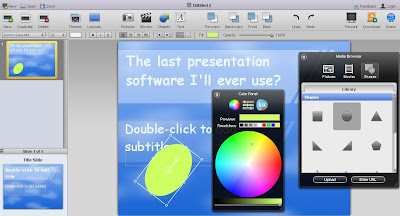
Perhaps even more impressive is the story behind the app, which you can hear in an interview on net@nite #57. When these guys set out to write web applications (like 280slides), they wanted a real development environment - like cocoa which they were familiar with having worked at Apple. So they built a cocoa-compatible/Objective-C like platform that runs in pure javascript. That's what is running 280slides, but building it is like building any old cocoa app. NB: the platform is still being kept internal, but their intention is to go open source when it is ready for the wild.
280North have only recently gone public with 280slides and the platform they have been building. Interesting to see at the same time we have Apple announcing a more conventional javascript library SproutCore. Can anyone spell a-c-q-u-i-s-i-t-i-o-n t-a-r-g-e-t?
Exciting times!
37signals arguably kicked of the current phase of web applications with basecamp that finally allow us to forget we are working in a browser (or was it writely? - now google docs).
Now we are seeing a selection of frameworks or products specifically designed for building modern RIAs. Rails is of course now fairly established in this space, but products like Flex, Air, Appcelerator and WaveMaker are redefining the envelope.
Well I'll be bold enough to say now that I think the guys from 280North have just redefined the cutting edge again with their powerpoint/keynote killer called 280Slides.
It's just out in public beta (isn't everything?), but I challenge you not to be impressed with just how much like a great piece of desktop software it is ... except you've also got the power of web access, sharing and delivery.

Perhaps even more impressive is the story behind the app, which you can hear in an interview on net@nite #57. When these guys set out to write web applications (like 280slides), they wanted a real development environment - like cocoa which they were familiar with having worked at Apple. So they built a cocoa-compatible/Objective-C like platform that runs in pure javascript. That's what is running 280slides, but building it is like building any old cocoa app. NB: the platform is still being kept internal, but their intention is to go open source when it is ready for the wild.
280North have only recently gone public with 280slides and the platform they have been building. Interesting to see at the same time we have Apple announcing a more conventional javascript library SproutCore. Can anyone spell a-c-q-u-i-s-i-t-i-o-n t-a-r-g-e-t?
Exciting times!
Tuesday, June 17, 2008
Doing one thing at a time
James Shore discussed Agile Release Planning on this recent PM podcast, and it was refreshing to hear the benefits of agile pitched to a product management audience.
Like the best ideas, the tenets of agile appear almost too simple to be true. "Master of the bleeding obvious" Basil Fawlty would say. Yet most organisations seem structurally incapable of behaving along these lines.
James' presentation is very entertaining, and well worth a listen. He keeps the agenda short and well tuned to a PM audience. Although the ideas are born from a software environment, they are largely transferable to other domains. A discussion of five concepts to help you increase the value you deliver in business:
Here's my version of the graphic to illustrate the point:

Like the best ideas, the tenets of agile appear almost too simple to be true. "Master of the bleeding obvious" Basil Fawlty would say. Yet most organisations seem structurally incapable of behaving along these lines.
James' presentation is very entertaining, and well worth a listen. He keeps the agenda short and well tuned to a PM audience. Although the ideas are born from a software environment, they are largely transferable to other domains. A discussion of five concepts to help you increase the value you deliver in business:
- Work on one project at a time .. it improves your ROI
- Release early and often .. get to market faster with a minimum, but valuable feature-set. Not only do you get to take advantage of the real customer voice sooner, but, again, better ROI.
- Adapt your plans .. to slavishly avoid change is to confound the opportunity to increase the value of your work as new things are learned along the way
- Conduct experiments .. your project can have many outcomes, and you will never know which is best unless you test options, collect data, and analyse
- Plan at the last responsible moment .. avoid costly planning that is basically trying to predict the future (unsuccessfully). The later the decision, the more information you will have available to make a good decision.
Here's my version of the graphic to illustrate the point:

Monday, June 16, 2008
bookjetty - a great new site to track, share, buy and borrow books
 I've fallen in love with bookjetty, a great new site for books by Herryanto Siatono.
Although my It's a Prata Life blog is officially dedicated to prata (and always will be!), I also use it to keep a diary of the books I'm reading. I probably always will, but I do make sure to try out all the "book tracking" sites, facebook apps and so on that I come across.
None have really jiggled my worm until I discovered bookjetty.
The killer feature for me is the great library integration on the site. It helps answer all the usual questions I have whenever I hear about a new book..
- Have I already got it or read it before?
- Does one of my friends have it? Maybe I can borrow it..
- Can I get it from the local library?
- Can I buy it online?
- (oh, and if the last two steps fail, I may actually visit a real bookstore!)
The bookjetty developer(s?) have done a great job of integrating the libraries, especially considering that most are still running archaic web 0.1 systems which are not very mashup friendly. I've posted before about a kludge to do library lookups from an amazon page, but it never works very reliably because of the dumb library catalogue it needs to talk to, so I can appreciate some of the challenges they may have had.
And here's an example of how the library checks appear...

If you are into books, I heartily recommend you go and register at bookjetty and check it out!
Sunday, June 15, 2008
Moving to Disqus for Comments
I recently moved this site's commenting feature to disqus.com after listening to the great interview with Daniel from Disqus on net@night#53. I see I'm not alone..
You may think A Blog Without Comments Is Not a Blog, and most people have reviewed Disqus in terms of the improved commenting features it provides.
There is another point of view that really hit home for me as I considered the move.
I remember the pre/early web days when I was a very heavy nntp (news) user. In the job I had at the time, it became my lifeline to various specialist groups where I would share the little I knew and was able to draw on the sometimes instantaneous feedback from a global community of peers. I think those days still rank as the best and most productive community networking experience I have ever had.
As the early web came to life there were many areas in which we took short-term hits for (hopefully) long term gain. We moved from (pre-Domino) Lotus Notes to web publishing for example, not because it was better but because it represented a broadly accessible, stanadards-based platform. Web 2.0 is I think only now starting to surpass the degree of interactivity you could achieve with Notes circa 98.
IMHO, collaboration is another area that's been through a similar process. Simplifying somewhat, I saw blogs and web-based forums as a bifurcation of the old collaboration experience I had with nntp. Blogs at least did a decent job of allowing anyone to publish what they thought was worth sharing. Web-based forums never really tickled my mustard however.
Implementations have never been quite as efficient for greasing collaboration as nntp, and they lack the universal federation model that nntp has always had baked in. It also meant that forum discussions and information publishing (via blogs etc) became divorced.

So when I look at Disqus (and other similar offerings), I see a scheme to finally re-unify the publishing and discussion worlds. Disqus provides the forum capability integrastes with tyhe blog publishing world, eliminating the question "should I blog it, post it to a forum, or both?"
As you can tell from my little diagram above, I don't see much role for web forums as we know them today in the new world of collaboration. Maybe I am overly negative, but it does make me smile/cringe whenever I hear someone talking about "web 2.0: you know, forums etc..."
I'm using blogger. Since there are various guides around for the manual integration of Disqus, I thought it would be worthwhile to report on how the process went for me.
I'm using customised blogger layouts for my blogs, and actually found that the automatic integration support built into the setup process on Disqus worked very well.
Just a few things to note:
You may think A Blog Without Comments Is Not a Blog, and most people have reviewed Disqus in terms of the improved commenting features it provides.
There is another point of view that really hit home for me as I considered the move.
I remember the pre/early web days when I was a very heavy nntp (news) user. In the job I had at the time, it became my lifeline to various specialist groups where I would share the little I knew and was able to draw on the sometimes instantaneous feedback from a global community of peers. I think those days still rank as the best and most productive community networking experience I have ever had.
As the early web came to life there were many areas in which we took short-term hits for (hopefully) long term gain. We moved from (pre-Domino) Lotus Notes to web publishing for example, not because it was better but because it represented a broadly accessible, stanadards-based platform. Web 2.0 is I think only now starting to surpass the degree of interactivity you could achieve with Notes circa 98.
IMHO, collaboration is another area that's been through a similar process. Simplifying somewhat, I saw blogs and web-based forums as a bifurcation of the old collaboration experience I had with nntp. Blogs at least did a decent job of allowing anyone to publish what they thought was worth sharing. Web-based forums never really tickled my mustard however.
Implementations have never been quite as efficient for greasing collaboration as nntp, and they lack the universal federation model that nntp has always had baked in. It also meant that forum discussions and information publishing (via blogs etc) became divorced.

So when I look at Disqus (and other similar offerings), I see a scheme to finally re-unify the publishing and discussion worlds. Disqus provides the forum capability integrastes with tyhe blog publishing world, eliminating the question "should I blog it, post it to a forum, or both?"
As you can tell from my little diagram above, I don't see much role for web forums as we know them today in the new world of collaboration. Maybe I am overly negative, but it does make me smile/cringe whenever I hear someone talking about "web 2.0: you know, forums etc..."
Notes on integrating Disqus with blogger
I'm using blogger. Since there are various guides around for the manual integration of Disqus, I thought it would be worthwhile to report on how the process went for me.
I'm using customised blogger layouts for my blogs, and actually found that the automatic integration support built into the setup process on Disqus worked very well.
Just a few things to note:
- I used the "upload template" feature to load the version modified for me by Disqus. I think because of this, I had to "expand widget templates" and save the template again after the upload to have it take effect.
- There is no import of existing comments yet (future feature), but it is possible to go back to old posts that do not yet have comments and switch them to Disqus mode by selecting the "Don't allow" reader comments post option.
Some more on secure social networking - iHazYrCreds
The other day I added my voice to the call to end the perfidious practice of social networking sites requesting your email password.
In the discussion I made an off-hand reference to a fictitious site called iHazYrCreds. Well, it's not fictitious any longer ;-) For better or worse, you can now visit iHazYrCreds.tardate.com to find out more about the common password traps to avoid.
I'd like to see the day when asking for an email password in order to "import contacts" is deemed totally unacceptable (and negligent professional practice).
I would also welcome any moves by the big email providers (google, yahoo etc) to explicitly outlaw such use in their terms of service. I'm no lawyer, but I believe it is debatable whether it is already a violation.
net.gain
| ..or "how to (try) and make the new economy work like the old one" I recently borrowed John Hagel III and Arther G. Armstrong's Net Gain: Expanding Markets Through Virtual Communities  from a colleague for a quick read. It was published in 1997 by McKinsey & Company, and I must say it kinda shows. The book suffers from a myopic pre-occupation with the dual assumptions that:
Ah, the golden days of the internet bubble! This is an interesting read if for no other reason than to see how far we have come; how much has been learnt, and how much we have yet to learn. |
As I studied the authors' recipe for profitable community-building I found myself challenging the principle that success requires an imposition of control by an organisation: the company studies the market, decides what community should be built, writes a business case for it, and appoints the expert team to design, build, launch, and market the community.
This is an astonishing proposition given the book's initial premise:
The rise of virtual communities .. has set in motion an unprecedented shift in power from vendors of goods and services to the customers who buy them.
"Over my dead body!" I can hear the voices echoing from the boardroom - undoubtedly the prime audience for this book, which I think could reasonably be subtitled "how to (try) and make the new economy work like the old one".
The idea of a "community" that is both external to the organisation while remaining under its control permeates the book, and is perhaps the primary misconception that has taken the past 10 years to rethink and recognise for the oxymoron that it is.
This is closely related to the fundamental yet unspoken assumption of a hard boundary between the corporation and the customer/community. In parts of the book that consider the use of communities within the corporation, the emphasis is very much on within the corporation, or at most, between business partners.
My comments have been a little disparaging, and it is perhaps unfair to find fault in failing to predict the future accurately. It does mean that this book is now little more than a historical curiosity.
However, the book I would be very interested to read is a "10th anniversary rewrite". For my money, I'd say that's Wikinomics: How Mass Collaboration Changes Everything
 (any other recommendations? I'm keen to hear..)
For now, I think I'll let Geek and Poke have the last word...

Originally posted on It's a Prata Life
Friday, June 06, 2008
'Promote Bad Security Practice' Grand Achievement Awards
As usual, Jeff cuts to the heart of the matter on Coding Horror when calling out Yelp for the astonishingly evil and unconscionable act of asking users to hand over their email passwords.
I am not sure who started this, but it has somehow scarily become accepted practice, especially among the social networking sites. Facebook, LinkedIn, Plaxo ... they all do it, and seem to think that waving some privacy mumbo-jumbo 'but you can trust US!' makes it OK. Some are particularly heinous, like Tagged, which obscure the fact that handing over your email password is optional.

As many have pointed out (see the comments on Jeff's post), this is a lazy solution to a problem that is solvable in ways that do not need to compromise user security.
Facebook, LinkedIn - these guys should know better. And I think have an obligation to do better, especially since it is becoming more and more common for a social networking site to be an individual's first experience on the net. While the old hands may have well-ingrained security awareness thanks to the evangelizing efforts of people like Steve Gibson and Leo Laporte on the Security Now! podcast, we have a whole new generation of users being taught exactly the wrong thing thanks to the misguided and irresponsible acts of the social networking sites that are requesting email passwords to be handed over.
The proliferation of this perfidious practice must be reversed! A good first step is to heap professional scorn on anyone associated with developing such a feature. Shame!


Tuesday, June 03, 2008
Oracle Release Timeline with Dipity
Derek Dukes was on net@nite #53 the other week, and it was really interesting to hear him talk about dipity.
Dipity is an experiment in information organisation, with time being the primary dimension currently being explored. Similar in a way to MIT's SMILE widget, which I was investigating a while back for visualizing time-based information.
Dipity shows a great deal of promise, and I like its emphasis on self-discovery and organisation information if directed (rather than everything having to be painstakingly entered). It is certainly a fun way to get lost for a few hours and learn a whole lot of stuff you never set out to study (just go to the home page and start checking out different timelines!)
Ulrich has already worked up a history of Oracle Releases. Not complete, but a fantastic visualisation that would be worth supporting and maintaining!
NB: I'm posting a static image here for now, because the embed code doesn't seem to work in all browsers at the moment.
Adding reCAPTCHA to Oracle SSO - now on sourceforge
Yes, it's time for some house cleaning!
One of my favourite little hacks is how to add reCAPTCHA to Oracle SSO, which I wrote about last year. I've now finally got around to setting it up with its own sourceforge project.
OssoRecaptcha is a demonstration of integrating the CAPTCHA service from recaptcha.org with Oracle Single-Sign-On. It can be used in production OSSO deployments, and also as an example of integrating any 3rd party authentication system with OSSO.
Monday, June 02, 2008
Request header rewrites with Java servlet filters - now on sourceforge
Some time back I posted a sample and discussion of request header rewrites with Java servlet filters, and I now finally got around to setting it up with its own sourceforge project.
RewriteRequestHeaderFilter is a Java servlet filter for request header rewrites according to regex rules specified in the servlet init parameters. It is packaged as a sample application and also jar that can be inserted into any arbitrary site.
RewriteRequestHeaderFilter is a Java servlet filter for request header rewrites according to regex rules specified in the servlet init parameters. It is packaged as a sample application and also jar that can be inserted into any arbitrary site.
Sunday, May 25, 2008
Config Files for Windows - an Enhancement
In a previous post, I described a general scheme for managing config files for Windows.
Well, there's a simple enhancement that I've added concerning how to locate the config file for the script in question.
The issue is that if I run a script, you always wanted to look for the config file relative to the script location. This can be easily done using Windows Batch Parameter Expansion. %~dp0 expands to the path of the current script, and %~n0 is the name of the script file. Hence, to name the appropriate config file for a script, we generate the name as follows:
set LOCALCONF=%~dp0conf\%~n0-%COMPUTERNAME%.cmd
Blog Stats
I want a t-shirt just like this for my birthday, except I'd change it to "..than MY blog" and add my url;-).

Originally posted on Prata Life..
Originally posted on Prata Life..
Business Networking that Doesn't Suck
I really like Geoffrey Grosenbach's ruby on rails podcast, especially because it's not just about rails (even though Rails is a keen interest of mine).
On the latest issue, I was excited to learn about biznik.com. "Business Networking that Doesn't Suck" as they say.
I immediately subscribed, but was disappointed to find that there's nothing happening in my local area yet (Singapore), at least not within 6000km.

Something that we should change soon, especially given the attention paid to entrepreneurship in Singapore. Take the efforts of SPRING for example, or the investment that the government is making in Interactive Digital Media.
I love the idea of this site, and hope to find some local compatriots up there soon!
On the latest issue, I was excited to learn about biznik.com. "Business Networking that Doesn't Suck" as they say.
I immediately subscribed, but was disappointed to find that there's nothing happening in my local area yet (Singapore), at least not within 6000km.
Something that we should change soon, especially given the attention paid to entrepreneurship in Singapore. Take the efforts of SPRING for example, or the investment that the government is making in Interactive Digital Media.
I love the idea of this site, and hope to find some local compatriots up there soon!
Saturday, May 24, 2008

Monday, May 19, 2008
Tu Plang, Unit and the Green Papaya
I've had Regurgitator's Tu-Plang and Unit  since when I was working in Sydney around 98/99. These albums are classics. I love their sound, and the lyrics are smart. They still get a regular listen, and that's not going to stop. In a twist, I saw recently on the Food Lover's Guide to Australia that Quan's mother established a Vietnamese restaurant in Brisbane called Green Papaya, and it has great reviews.  It was Hanoi-born Lien Yeomans's dream come true - opening her own restaurant. At Brisbane's Green Papaya she cooks dishes from North Vietnam. She says she has her rock star son Quan to thank for her fame (he’s with the band Regurgitator) but we think it’s her recipes, each one linked to a personal story from her incredible life. |
View Larger Map
Sunday, May 18, 2008
Calendar
| Day to day, our time is marked by weeks, months and years. We take it for granted that no matter where you are on earth, you always know where you are in time. The calendar is such a routine concept that it takes a book like David Ewing Duncan's excellent and most engaging Calendar  to make you stop and think. A 7-day week is completely arbitrary for instance, apparently originating circa 700 BC in Babylon, and probably influenced by the seven known planets (at the time). Months are confusion personified. Inspired by the lunar cycle, one is left with the dilemma of trying to fit the cycles within the solar year. The chart below (produced with the open source lcap program) is probably the easiest way to see how the lunar months drift in relation to the solar year. Some, like the Greek astronomer Metron, attempt to rationalise the relationship with great precision (the 19-year Metronic cycle has 7 years of 13 lunar months followed by 12 years of 12 lunar months. Even that is not completely accurate). To most calendarists however, months scarcely retained a notional relationship to the moon, becoming little more than convenient units of time upon which to hang the names of Gods and Emperors. |

NB: the difficulty in tracking the moon also came up in relation to the challenge of measuring longitude. Accurate moon charts would have allowed mariners to determine their position even in the absence of accurate time-keeping devices. Predicting the moon's course in the end proved to be much more challenging than building a clock that could survive a nautical adventure and still keep good time. See Dava Sobel's Longitude.
The idea of the solar year - the complete cycle of the seasons from one solstice to the next - is fundamental to how we conceive the passage of time. But we don't often think about the difference between a sidereal year (time for the earth to complete one complete orbit of the sun), and the tropical year (time from one vernal [spring/March] equinox to the next). Or the fact that the year is so very slightly different if you measure between the June or December solstices or the September equinox. And then consider that the Earth is a huge object hurtling through space and subject to varying gravitational forces and other bumps and jitters.
Once you have boiled all this down, it seems a "day" is about the only fundamental unit of calendar time that makes sense. Everything else is just convention and approximation!
Considering the difficulty of measurement, and the many social, political and religious factors involved in common convention, it is quite extra-ordinary that we even have a universally accepted calendar today.
It is easy to forget just how recent a phenomenon this is, and how long its introduction was in the making.
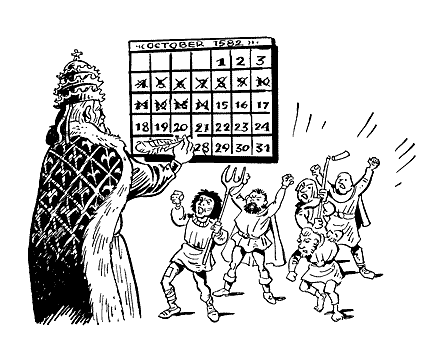 The Gregorian calendar we use today was officially launched by Pope Gregory in 1582, but it wasn't introduced in Britain until 1752 with many countries not adopting it until the 20th century (for example, Russia in 1918 and Greece in 1924). Many quote Mao Zedong declaration of the People's Republic of China in October 1949, which included a point on the adoption of the Gregorian calendar, as the final triumph for a universal calendar (although many cultures still maintain parallel systems such as the Chinese lunar calendar). But do not forget that the flaws in Julius Ceasar's previous calendar had been know long before - the cause of much consternation at the Council at Nicaea in AD325 over the scheduling of Easter, and the subject of the monk Roger Bacon's most distressed entreaty to Pope Clement in 1266 to:
.. apply excellent remedies in this particular .. If then this glorious work should be performed in your Holiness' time, one of the greatest, best, and finest things ever attempted in the Church of God would be consummated.
All of this is of course the background to an epic tale that finds a thread through all peoples over all time.
Which is really the genius of David Duncan's work. He is a great explainer, and in telling the story of the calendar, he tells the story of much of human civilization. And where other "histories of the world" tend to struggle to fit a narrative thread across time and place, the story of the calendar provides Duncan with a perfect segue. The result is the most enjoyable, understandable and effective history lesson I have ever had.
If you have just the slightest interset in history or how the calendar came about as we know it, I couldn't recommend this book more highly.
Other interesting facts:
- In Britain, New Years Day was celebrated on March 25, the Feast of the Assumption, until it was changed to January 1 in 1752. There are over 30 definitions of New Year listed on wikipedia.
- Until the modern era of atomic clocks, the most accurate measurement of the year was by Abu Allah Mohammed Ibn Jabir al-Battani in AD 882 (22 seconds short). al-Battani's work came from the same period of Arab innovation that produced modern algebra and added "zero" to the nine Indian symbols that eventually became our familiar number system.
Calendar for December from a French Book of Hours, written around 1470:

Easter table, England, 1073:

Originally posted on Pratalife
Tuesday, May 06, 2008
Configuration Files - a pattern for windows batch scripts
It's a very common practice in perl and linux/unix shell scripting to use an external configuration file (.conf or .properties), keeping all the script's necessary settings organised tidily in one place. This makes it easier to configure in the first place (because you don't have to hunt through the whole script to find what needs tweaking, or which environment variables need to be set), and also makes maintenance of the script so much easier (because you don't need to reconfigure after installing an updated script).
 For some reason though, this practice never seemed to get widely adopted in the Windows batch file world. Either Windows script-kiddies just never learned to think like a sysadmin, or we never expected the DOS shell to be capable enough! Or maybe we never bothered, because surely windows batch files should be extinct by now?
I guess the dominant approaches to configuring batch files on Windows are:
Well, it is possible to take advantage of the elegance of external configuration files. For some time I've been using a technique that I adapted from what I'd normally do with perl and bash scripts. I'm sure this was invented decades ago, but it surprises me that I haven't yet found a good example or tutorial on the net.
So I thought maybe time to polish up the "pattern" and share it here.
 It's pretty simple! The flowchart on the right provides an overview.
To make this work with simple windows batch files, we use a configuration file that it itself a batch file (.bat or .cmd) and it is called from the main script. The configuration file would usually set a range of environment variables
A nice usability touch is that when the script is first executed (i.e. no configuration file present), it will generate a default configuration file, give the user some helpful instructions on how to edit the configuration file, and exit.
This makes your script "safe" for users who are liable to run it just to find out what it does(!).
But it also means that you can maintain the default configuration file structure - with as much built-in documentation as you like - inside the script itself (therefore only one file to maintain).
If you have multiple scripts that all need to share a common configuration, you can extract the config file handling as a separate script and include (call) that from all the others. See the scriptTemplate.cmd and config.cmd in this kit of examples.
At that point, the user could edit the configuration file if necessary.
Subsequent runs pick up the settings in the configuration file.
 For some reason though, this practice never seemed to get widely adopted in the Windows batch file world. Either Windows script-kiddies just never learned to think like a sysadmin, or we never expected the DOS shell to be capable enough! Or maybe we never bothered, because surely windows batch files should be extinct by now?
I guess the dominant approaches to configuring batch files on Windows are:
- Command line arguments [painful if you have too many, annoying if they are invariant for your setup, and may entice you to write a wrapper script just to save all the typing]
- Environment variables [can lead to pollution of your environment, but also not usually backed up along with your scripts]
- Good ol' "just edit the batch file and fill in the settings" approach
Well, it is possible to take advantage of the elegance of external configuration files. For some time I've been using a technique that I adapted from what I'd normally do with perl and bash scripts. I'm sure this was invented decades ago, but it surprises me that I haven't yet found a good example or tutorial on the net.
So I thought maybe time to polish up the "pattern" and share it here.
The Pattern
 It's pretty simple! The flowchart on the right provides an overview.
To make this work with simple windows batch files, we use a configuration file that it itself a batch file (.bat or .cmd) and it is called from the main script. The configuration file would usually set a range of environment variables
A nice usability touch is that when the script is first executed (i.e. no configuration file present), it will generate a default configuration file, give the user some helpful instructions on how to edit the configuration file, and exit.
This makes your script "safe" for users who are liable to run it just to find out what it does(!).
But it also means that you can maintain the default configuration file structure - with as much built-in documentation as you like - inside the script itself (therefore only one file to maintain).
The Script Template
Here's a script template that includes the configuration file handling (also available for download here). As you can see, not rocket science!If you have multiple scripts that all need to share a common configuration, you can extract the config file handling as a separate script and include (call) that from all the others. See the scriptTemplate.cmd and config.cmd in this kit of examples.
@echo off
REM $Id$
setlocal
echo Welcome to %0
REM Initialise the config flag [CONFIGSET] and config file [LOCALCONF]
REM You must name the config file .bat or .cmd to ensure Windows can execute it cleanly
set CONFIGSET=NO
set LOCALCONF=%~dp0conf\%~n0-%COMPUTERNAME%.cmd
REM ===============================================================
REM Configuration section
REM ---------------------------------------------------------------
if "%LOCALCONF%"=="" goto config_help
goto config_do
:config_help
echo This is a configuration help script
echo Call from another script with first parameter being the config file name
echo This script will set the variable CONFIGSET
echo CONFIGSET=NO in the case of error or undefined configuration
echo CONFIGSET=YES in the case where configuration has been successfully read
goto config_exit
:config_do
REM handle configuration file
IF EXIST %LOCALCONF% goto config_cont
REM generate default setting file
REM adapt this to you needs. Here are some samples
echo REM configuration file> %LOCALCONF%
echo set JAVA_HOME=C:\bin\jdk1.6.0_03>> %LOCALCONF%
echo set TMPFILE=c:\temp\mytemp.txt>> %LOCALCONF%
echo set SUBJECT=A subject line>> %LOCALCONF%
echo set DBUID=dbusername>> %LOCALCONF%
echo set DBPWD=dbpassword>> %LOCALCONF%
echo #
echo # Local configuration not yet set.
echo # A default configuration file (%LOCALCONF%) has been created.
echo # Review and edit this file, then run this process again.
echo #
goto config_exit
:config_cont
call %LOCALCONF%
set CONFIGSET=YES
:config_exit
if "%CONFIGSET%"=="YES" goto config_ok
echo Configuration is not set
goto exit
:config_ok
REM ---------------------------------------------------------------
REM Configuration section ends
REM ===============================================================
echo The main script starts from here.
echo The following configuration is set:
echo JAVA_HOME=%JAVA_HOME%
echo TMPFILE=%TMPFILE%
echo SUBJECT=%SUBJECT%
echo DBUID=%DBUID%
echo DBPWD=%DBPWD%
:exit
endlocal
Sample Output
Here's an example of running the script above. The first time through, no configuration file is detected, so it creates one and exits.At that point, the user could edit the configuration file if necessary.
Subsequent runs pick up the settings in the configuration file.
D:\MyDocs>scriptWithConfigTemplate.cmd
#
# Local configuration not yet set.
# A default configuration file (scriptWithConfigTemplate-conf.bat) has been created.
# Review and edit this file, then run this process again.
#
Configuration is not set
D:\MyDocs>scriptWithConfigTemplate.cmd
The main script starts from here.
The following configuration is set:
JAVA_HOME=C:\bin\jdk1.6.0_03
TMPFILE=c:\temp\mytemp.txt
SUBJECT=A subject line
DBUID=dbusername
DBPWD=dbpassword
D:\MyDocs>
Sunday, May 04, 2008
Complex ACL filters with OVD
Access Control Rules are a very important aspect to get right when setting up Oracle Virtual Directory. But at the same time, I guess they are probably the most complex configuration option, especially if you haven't had some hard core LDAP experience before.
In Using OVD Filtered Directories for LDAP Authentication, I talked about using ACLs to restrict access to certain parts of a directory: each Access Control Rule has a filter setting, which is an LDAP filter that specifies which directory entries the rule applies to.
However I also discovered that using complex (multiple term) Access Control Rule filters is a great way to kill the OVD server process.
Say, for example, you wanted to grant access to entries for the ITGroup and HR departments. In RFC 4515 LDAP search filter terms, we can write this simply as:

But as mentioned, this will kill your OVD server (OVD 10.1.4.0.1 build 06.07.19).
There is a simple work-around though, by reverting to simple set theory and write multiple rules. In other words, granting (|(departmentNumber=ITGroup)(departmentNumber=HR)) is equivalent to two rules applied in sequence:

In Using OVD Filtered Directories for LDAP Authentication, I talked about using ACLs to restrict access to certain parts of a directory: each Access Control Rule has a filter setting, which is an LDAP filter that specifies which directory entries the rule applies to.
However I also discovered that using complex (multiple term) Access Control Rule filters is a great way to kill the OVD server process.
NB:it bombs with a java.lang.NullPointerException, and it is necessary to go and manually remove the offending filter from the $OVD_HOME/conf/acls.os_xml file on the server before it will startup again.
Say, for example, you wanted to grant access to entries for the ITGroup and HR departments. In RFC 4515 LDAP search filter terms, we can write this simply as:
(|(departmentNumber=ITGroup)(departmentNumber=HR))

But as mentioned, this will kill your OVD server (OVD 10.1.4.0.1 build 06.07.19).
There is a simple work-around though, by reverting to simple set theory and write multiple rules. In other words, granting (|(departmentNumber=ITGroup)(departmentNumber=HR)) is equivalent to two rules applied in sequence:
- Grant: (departmentNumber=ITGroup)
- Grant: (departmentNumber=HR)

Sunday, April 13, 2008
Innovation and Two Book Recommendations
There's a great quote in Chad Fowler's My Job Went to India which I just posted a quick review of: In business, ideas are dime a dozen. It's the blood, sweat, tears and money you pour into a product that make it really worth something.I'd extend that and link it to a later part of the book that focuses on Execution. To be successful, raw ability will get you only so far. The final stretch is populated by closers - people who finish things.As Theodore Levitt said: Creativity is thinking up new things. Innovation is doing new things.In other words, the key is doing. One of my pet subjects;-) I can come up with a million creative ideas, but without follow-through, its all just a bit of mental fun. An excellent companion read is Scott Berkun's The Myths of Innovation. Get them both on your bookshelf! The sooner, the better. |
Subscribe to:
Posts (Atom)