Can you trust your agile planning process to deliver the best result over time?
In an ideal world with a well-balanced and high-performing team, theory says it should all be dandy. But what happens when the real world sticks it's nose in and you need to deal with varying degrees of disfunction?
Feature Lifecycle Analysis is a technique I've been experimenting with for a few years. The idea is to visualise how well we are doing as a team at balancing our efforts between new feature development, refinement, maintenance and ultimately feature deprecation.
If you'd like to find out more, and run an analysis on your own projects, try out the Feature Lifecycle Analysis site. It includes some analysis of two real software development projects, and also a tool for analysing your own PivotalTracker projects.
As always, all notes, schematics and code are on GitHub.
My occasional technical diary of thoughts, tips, and tools from some of the more interesting things I'm playing around with at the time. That means all things Web, Open Source, Polyglot-programming, Electronics and Data, or just my latest rant.. who knows!
Showing posts with label Product Management. Show all posts
Sunday, July 10, 2016
Tuesday, June 01, 2010
10 Tips to boost SaaS customer conversion
@DaveMcClure gave a great keynote this morning at #echelon2010, and he emphasized a selective focus on critical metrics to drive your business.
This post is all about improving conversion (customer activation) rates for SaaS companies, suggesting 10 areas where things often go wrong. If you are a SaaS company, I expect this is one of your key metrics and I hope the article provides some hints on where to look for your next round of improvements.
Last year I started CloudJetty, which is a directory of cloud/SaaS products. Since then I've researched almost 1000 different product offerings for potential listing. Aside from being a tremendous learning experience and really opening my eyes to the incredible range of products available, I guess it was inevitable that I'd develop a critical eye for how SaaS products are presented on the web.
I started making notes; patterns appeared; and when Dave mentioned activation today I thought it was about time I bullied my thoughts into an actionable top 10 that I could share.
My main observation was that after getting users to your site, many SaaS companies seemed to slip up in relatively trivial ways in the quest to convert. It points to a few simple interventions that could have a marked impact on your activation rates. After a good shuffle, my top 10 stands like this:
Most of these are also not exclusively issues for SaaS companies, but I couch this specifically for SaaS because I believe they face particular challenges.
Cloud Computing is one of the most significant trends in IT, and 2010 is likely to be remembered as the year the cloud went mainstream. While many established vendors have been busy cloud-washing their products, we've also seen an incredible number of new products hit the market - in part because cloud infrastructure has itself drammatically reduced the cost of entry of delivering applications in the cloud (Software-as-a-Service / SaaS).
If you are in the business of building and providing a SaaS product, this is a mixed blessing. Yes, a rising tide floats all boats. But at the same time, the market is getting very crowded, very quickly. Standing out from the competition, and getting users to at least try your service is as tough as it's ever been. You don't want to make it any harder for yourself than it has to be.
Before we dive into the Top 10, I should be clear that this is based purely on my personal research and evaluation. There's no science or measurement to back this up.
If you have a Cloud/SaaS product, I'd simply encourage you take a fresh look at your website and use this as a quick checklist. If you "fail" any points, take these as areas you might want to review in more detail with you team to decide if you need to take action.
In short, forgive me if this sounds a bit preachy, and take it in the spirit it is offered: observations from a bloke who has looked at many SaaS sites and is offering some suggestions for the benefit of us all. I sincerely look forward to any feedback and additional suggestions you may have.
That said, here we go...
Figuring out what you are offering should not require the skills of an investigative journalist. Anything less than bleeding obvious then your chances of activating a new user take an immediate nose dive.
This is easier said than done, but it is still surprising how many SaaS sites fail to get this right. The three most common problems I've seen:
While this is a well-known web design challenge, it is particularly critical for SaaS. The product may not only be inherently complex or conceptual (e.g. subscription billing, sales force automation), but you also need to engage customers who are new to the whole cloud distribution channel.
How to fix this? First, you need good copy. Hire a skilled writer if needed to capture the essence of your product in concise, straight-forward language. Don't confuse this with writing a tag line or motto. It is about delivering the 5 bullet points or 20 word description that gets people past the "Ahah, I understand what you do" moment.
Next, you need a place to put it, which may require a review of your home page / landing page web design. Don't hide it on an About page; make sure it is up front and cannot be missed. If you do a good enough job, you may find your About page becomes redundant or can be relegated to a more detailed backgrounder.
One of the benefits of having a wonderfully succinct product description is that you make it so much easier for people to tell other people about what you offer.
This is particularly important for business software, where a bit of internal lobbying may be required to get the ball rolling.
Why make it difficult for people to write the email:
Many sites make this so difficult, the poor person who is trying to be your champion literally has to rewrite or reinvent the way to describe your product in order to tell other people about it.
These people are trying to sell your product for you, so it's probably a good idea to make their life as easy as possible! Consider helping them out..
There are quite a few SaaS companies that do a great job of communicating what they sell, but then totally lose the plot when it comes to being clear about what I can buy.
The distinction may be subtle, but it is critical for making it easy for me to hand over my money.
I may immediately grasp that you sell small business accounting solutions, but then get completely lost trying to understand whether I need the premium edition or the SOHO suite, with or without the active ledger integrator pack or advanced payments option. And does option mean I pay extra, or just that it may or may not work depending on my bank?
Some of the more mature SaaS offerings also fall into the "platform trap". You will recognise these by the tiered architecture diagrams. The confusion arises when trying to understand whether platform layers and vertical modules are just part of the product's logical design, or whether these represent separately licensed components.
Basically I want to buy, but I can't - because I'm confused or paralysed by too many options.
The most common solution these days tends to be the simple tiered payment plans, with a matrix of features available in each plan.
No kidding, I've seen too many sites that sell me a great product story but for the life of me I cannot discover how to register or purchase. These tend to be the brochureware-gone-wild type sites.
Some I suspect are companies that don't support a direct sales channel, but if this is the case I don't know why I'm not directed to a distribution partner.
If you are still pre-launch, there's no excuse for not providing at least a mailing list, guest book, facebook or twitter account that I can connect to.
True SaaS products have a huge advantage over traditional software: there is no shipping, distribution, installation or configuration phase to get in the way of instant gratification.
Which makes it baffling why so many purportedly cloud players do not capitalize on the opportunity for the impulse buy and immediate activation.
If you do not offer immediate sign-up, my first thoughts are frankly:
Neither reaction is beneficial for your business. If you can't already offer immediate registration, why is that? Is it a legal issue, engineering challenge or side-effect of your sales commission and distribution channel agreements?
The most common and apparently successful pattern is to enable immediate sign-up for a time-limited trial or basic free plan (the freemium model). Your foot is in the door, and the chances of coverting these users to paid plans just took a big leap forward.
I'd suggest that a free trial has already become a standard customer expectation. You seriously risk being passed over without a thought if you do not offer a free trial.
Whether you offer a freemium model is a trickier decision. Many are finding it hard to make fremium work in practice (such as Ning who recently switched to the free trial/paid model after years of trying to make fremium pay). The catch is that you must provide an incredibly compelling differentiation between free and paid, while at the same time not making your free plan so brain dead that it turns people away before they even consider paying. Not an easy feat.
I think there is still a valid place for freemium offerings in the business applications space, specifically because it is easy to define free/paid thresholds that make sense e.g. free to invoice up to 3 customers, but 4+ become paid services.
Quite a number of SaaS sites offer a free trial or demo account without disclosing the pricing details for the real thing.
People aren't stupid, and I suspect most are immediately on the lookout for the bait and switch. Even if everything is above board, I am disinclined to waste my time signing up for a trial in the first place if I have no way of knowing whether the eventual costs will even be close to my budget.
It seems to have become the industry norm for SaaS companies to openly publish their pricing (usually a prominent "Plans / Pricing" link). If you can't or won't do the same, it will inevitably turn some people away.
There is a special problem of course if your service is in beta and the pricing of monetization plan hasn't been finalised. I think the best you can do is just be transparent and avoid giving your users any nasty surprises.
It is surprising the number of sites that make it difficult or impossible to identify who is really behind the site. Doing so just creates additional buyer resistance, which you don't need.
If you are offering applications for business, trust will be a significant factor in the decision to start using your product. The more sensitive and critical the information and processes involved, the higher the trust threshold will be.
In the consumer space, it may be sufficient to identify yourself simply as a web address (with perhaps an associated company). But smart businesses will want to know a little more about who you are before committing to a relationship.
That doesn't mean you need the brand recognition of Google or Salesforce, but you should be more than just an IP address.
The objective is to present your company as a tangible entity that exists in the real world and is able to entertain a serious business relationship. Admittedly, geography can be a double-edged sword. There's a big difference between having a business address in Prague or Palo Alto. But play to your strengths and don't be unnecessarily silent about where you operate in the real world.
You can find quite a number of SaaS sites that do the right thing and identify the corporate entity behind the operation, but when you visit the corporate site, there's no return link or mention of the SaaS product offering.
This is quite common with SaaS offerings that have spun out of a web design or development company, or have been obtained as part of merger and acquisition activity.
When you discover this as a potential customer, the impact is hugely negative. It raises questions about the degree of corporate support, and the prospect that the SaaS site may be on the verge of being cut lose or wound up.
Mostly I suspect this is an oversight, or just content management problems where web properties are under the control of unrelated groups. Eminently fixable. Do it!
SaaS is still in its early days, and so adopters are clearly taking a risk when compared to "traditional" approaches, especially in a business context. That risk equation is significantly rebalanced if there's a clear way for users to recover their data if things go pear shape.
Google made one of the boldest steps to address this issue when it established the Data Liberation Front.
The large majority of SaaS sites are completely silent on the ability for users to extract their data from the service in a usable format. You can remove this as a barrier to adoption by providing a suitable data interface and being clear about this in your product documentation.
Better yet is to have an full open API, and support for data/integration standards that are relevant in your domain. But getting the data out is fundamental.
Smartphones - iPhone, Blackberry, Android and so on - are becoming the norm in business. And now we are looking at a new wave of tablet devices lead by the iPad (already 2 million units shipped) and a mob of android-based tablets on the way.
Increasingly, business functions are migrating from traditional computing platforms to these devices. CRM, contact management and social networking are already there.
So expect the questions like: "do you work on mobile? Do you have a native iPhone/iPad/Android application?"
Again, many SaaS sites are silent on the topic. Your web site may already be optimized for mobile browsers. Make sure we know it. Do you have plans for mobile applications? Make sure it is clear it is in the roadmap.
It is not a topic you should be silent about (unless you truly have nothing to offer).
We are all becoming familiar with marketplaces for mobile applications, digital books and videos. It is likely only a matter of time before marketplaces are to become significant distribution channels for SaaS applications.
Already we see the rise of platform-specific marketplaces such as Google Apps Marketplace, Salesforce AppXchange, Intuit Marketplace and others. And we have emerging platform-neutral marketplaces such as Cloudomatic and my own CloudJetty.
Smart SaaS providers will be watching closely to see how they can leverage the marketplaces to garner new users.
I've avoided citing examples of how to do it badly, mainly because these are such common problems it seems unfair to pick on one or two unlucky puppies.
But here's a pretty random example of a site that does a decent job of it.
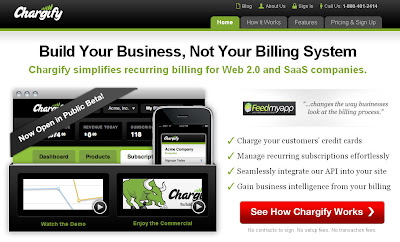
Chargify simplifies recurring billing for Web 2.0 and SaaS companies. They have a tiered pricing based on the number of customers processed, with a free plan that will get you up to 50 customers. I can sign up now and immediately create a hosted payment page and start doing business.
It took me all of 5 seconds to figure that out. Brilliant!

Blogarhythm for this post: Why don't you do right - Peggy Lee (2010 remix)
This post is all about improving conversion (customer activation) rates for SaaS companies, suggesting 10 areas where things often go wrong. If you are a SaaS company, I expect this is one of your key metrics and I hope the article provides some hints on where to look for your next round of improvements. Last year I started CloudJetty, which is a directory of cloud/SaaS products. Since then I've researched almost 1000 different product offerings for potential listing. Aside from being a tremendous learning experience and really opening my eyes to the incredible range of products available, I guess it was inevitable that I'd develop a critical eye for how SaaS products are presented on the web.
I started making notes; patterns appeared; and when Dave mentioned activation today I thought it was about time I bullied my thoughts into an actionable top 10 that I could share.
My main observation was that after getting users to your site, many SaaS companies seemed to slip up in relatively trivial ways in the quest to convert. It points to a few simple interventions that could have a marked impact on your activation rates. After a good shuffle, my top 10 stands like this:
- What does it do?!? Be clear about what you are selling
- Help me tell others what you sell
- Products, Editions, Features - Be clear about what I can buy
- Let me buy it!
- Can I sign-up now?
- Be clear about future costs
- Who are you?
- Do your Corporate and SaaS sites agree?
- Can I get my data?
- You have mobile support of course?
- Bonus #11: Watch the evolution of Application Marketplaces
Most of these are also not exclusively issues for SaaS companies, but I couch this specifically for SaaS because I believe they face particular challenges.
Cloud Computing is one of the most significant trends in IT, and 2010 is likely to be remembered as the year the cloud went mainstream. While many established vendors have been busy cloud-washing their products, we've also seen an incredible number of new products hit the market - in part because cloud infrastructure has itself drammatically reduced the cost of entry of delivering applications in the cloud (Software-as-a-Service / SaaS).
If you are in the business of building and providing a SaaS product, this is a mixed blessing. Yes, a rising tide floats all boats. But at the same time, the market is getting very crowded, very quickly. Standing out from the competition, and getting users to at least try your service is as tough as it's ever been. You don't want to make it any harder for yourself than it has to be.
Before we dive into the Top 10, I should be clear that this is based purely on my personal research and evaluation. There's no science or measurement to back this up.
If you have a Cloud/SaaS product, I'd simply encourage you take a fresh look at your website and use this as a quick checklist. If you "fail" any points, take these as areas you might want to review in more detail with you team to decide if you need to take action.
In short, forgive me if this sounds a bit preachy, and take it in the spirit it is offered: observations from a bloke who has looked at many SaaS sites and is offering some suggestions for the benefit of us all. I sincerely look forward to any feedback and additional suggestions you may have.
That said, here we go...
1. What does it do?!?

Figuring out what you are offering should not require the skills of an investigative journalist. Anything less than bleeding obvious then your chances of activating a new user take an immediate nose dive.This is easier said than done, but it is still surprising how many SaaS sites fail to get this right. The three most common problems I've seen:
- Omit a meaningful description altogether(!)
- Provide a description, but one that is so grandiose, conceptual and all-encompassing that it doesn't help at all
- There is a good description, but it is burried somewhere in an About page or other secondary page
While this is a well-known web design challenge, it is particularly critical for SaaS. The product may not only be inherently complex or conceptual (e.g. subscription billing, sales force automation), but you also need to engage customers who are new to the whole cloud distribution channel.
How to fix this? First, you need good copy. Hire a skilled writer if needed to capture the essence of your product in concise, straight-forward language. Don't confuse this with writing a tag line or motto. It is about delivering the 5 bullet points or 20 word description that gets people past the "Ahah, I understand what you do" moment.
Next, you need a place to put it, which may require a review of your home page / landing page web design. Don't hide it on an About page; make sure it is up front and cannot be missed. If you do a good enough job, you may find your About page becomes redundant or can be relegated to a more detailed backgrounder.
2. Help me tell others what you do
One of the benefits of having a wonderfully succinct product description is that you make it so much easier for people to tell other people about what you offer.
This is particularly important for business software, where a bit of internal lobbying may be required to get the ball rolling.
Why make it difficult for people to write the email:
Hi Boss,
We've being talking about improving our project invoicing for ages. Well, I found this site {paste URL here} that seems a perfect fit.
It offers {paste wonderfully succint description here}.
Certainly seems to address all the problems we've identifed - can we add it to the weekly meeting for a demo and decision on trying it out?
Many sites make this so difficult, the poor person who is trying to be your champion literally has to rewrite or reinvent the way to describe your product in order to tell other people about it.
These people are trying to sell your product for you, so it's probably a good idea to make their life as easy as possible! Consider helping them out..
- Don't lock up key product descriptions in images. Make sure the important stuff is text that can be copied
- Avoid relying too heavily on customer quotations for the bulk of your site copy. These may convince me, but re-quoting a quote doesn't usually help me convince others
- Provide graded levels of detail in your product information. Many sites have high level taglines, a very detailed technical data sheet, but not much in between
3. Products, Editions, Features - so, what exactly do I buy?

There are quite a few SaaS companies that do a great job of communicating what they sell, but then totally lose the plot when it comes to being clear about what I can buy.The distinction may be subtle, but it is critical for making it easy for me to hand over my money.
I may immediately grasp that you sell small business accounting solutions, but then get completely lost trying to understand whether I need the premium edition or the SOHO suite, with or without the active ledger integrator pack or advanced payments option. And does option mean I pay extra, or just that it may or may not work depending on my bank?
Some of the more mature SaaS offerings also fall into the "platform trap". You will recognise these by the tiered architecture diagrams. The confusion arises when trying to understand whether platform layers and vertical modules are just part of the product's logical design, or whether these represent separately licensed components.
Basically I want to buy, but I can't - because I'm confused or paralysed by too many options.
The most common solution these days tends to be the simple tiered payment plans, with a matrix of features available in each plan.
4. Let me buy it!
No kidding, I've seen too many sites that sell me a great product story but for the life of me I cannot discover how to register or purchase. These tend to be the brochureware-gone-wild type sites. Some I suspect are companies that don't support a direct sales channel, but if this is the case I don't know why I'm not directed to a distribution partner.
If you are still pre-launch, there's no excuse for not providing at least a mailing list, guest book, facebook or twitter account that I can connect to.
5. Can I sign-up now?

True SaaS products have a huge advantage over traditional software: there is no shipping, distribution, installation or configuration phase to get in the way of instant gratification. Which makes it baffling why so many purportedly cloud players do not capitalize on the opportunity for the impulse buy and immediate activation.
If you do not offer immediate sign-up, my first thoughts are frankly:
- You are not a true SaaS/cloud player. Cloud-washing alert!
- You have let your bureaucratic and legal processes overwhelm common sense. You are obviously not the agile, customer-focused company that I'd like to do business with
Neither reaction is beneficial for your business. If you can't already offer immediate registration, why is that? Is it a legal issue, engineering challenge or side-effect of your sales commission and distribution channel agreements?
The most common and apparently successful pattern is to enable immediate sign-up for a time-limited trial or basic free plan (the freemium model). Your foot is in the door, and the chances of coverting these users to paid plans just took a big leap forward.
I'd suggest that a free trial has already become a standard customer expectation. You seriously risk being passed over without a thought if you do not offer a free trial. Whether you offer a freemium model is a trickier decision. Many are finding it hard to make fremium work in practice (such as Ning who recently switched to the free trial/paid model after years of trying to make fremium pay). The catch is that you must provide an incredibly compelling differentiation between free and paid, while at the same time not making your free plan so brain dead that it turns people away before they even consider paying. Not an easy feat.
I think there is still a valid place for freemium offerings in the business applications space, specifically because it is easy to define free/paid thresholds that make sense e.g. free to invoice up to 3 customers, but 4+ become paid services.
6. Be clear about future costs
Quite a number of SaaS sites offer a free trial or demo account without disclosing the pricing details for the real thing.
People aren't stupid, and I suspect most are immediately on the lookout for the bait and switch. Even if everything is above board, I am disinclined to waste my time signing up for a trial in the first place if I have no way of knowing whether the eventual costs will even be close to my budget.
It seems to have become the industry norm for SaaS companies to openly publish their pricing (usually a prominent "Plans / Pricing" link). If you can't or won't do the same, it will inevitably turn some people away.
There is a special problem of course if your service is in beta and the pricing of monetization plan hasn't been finalised. I think the best you can do is just be transparent and avoid giving your users any nasty surprises.
7. Who are you?
It is surprising the number of sites that make it difficult or impossible to identify who is really behind the site. Doing so just creates additional buyer resistance, which you don't need.If you are offering applications for business, trust will be a significant factor in the decision to start using your product. The more sensitive and critical the information and processes involved, the higher the trust threshold will be.
In the consumer space, it may be sufficient to identify yourself simply as a web address (with perhaps an associated company). But smart businesses will want to know a little more about who you are before committing to a relationship.
That doesn't mean you need the brand recognition of Google or Salesforce, but you should be more than just an IP address.
- Get the advice and make the effort to ensure your SaaS business is appropriately incorporated.
- Clearly state the company name in your web footer/copyright notice and link it to the company contact or information page
- Include your real-world contact details and physical office address (if you have one)
- Quote your business registration number, and make sure the country or legal jurisdiction is clear.
The objective is to present your company as a tangible entity that exists in the real world and is able to entertain a serious business relationship. Admittedly, geography can be a double-edged sword. There's a big difference between having a business address in Prague or Palo Alto. But play to your strengths and don't be unnecessarily silent about where you operate in the real world.
8. Do your Corporate and SaaS sites agree?
You can find quite a number of SaaS sites that do the right thing and identify the corporate entity behind the operation, but when you visit the corporate site, there's no return link or mention of the SaaS product offering.
This is quite common with SaaS offerings that have spun out of a web design or development company, or have been obtained as part of merger and acquisition activity.
When you discover this as a potential customer, the impact is hugely negative. It raises questions about the degree of corporate support, and the prospect that the SaaS site may be on the verge of being cut lose or wound up.
Mostly I suspect this is an oversight, or just content management problems where web properties are under the control of unrelated groups. Eminently fixable. Do it!
9. Can I get my data?
SaaS is still in its early days, and so adopters are clearly taking a risk when compared to "traditional" approaches, especially in a business context. That risk equation is significantly rebalanced if there's a clear way for users to recover their data if things go pear shape.
Google made one of the boldest steps to address this issue when it established the Data Liberation Front.
Users should be able to control the data they store in any of Google's products. Our team's goal is to make it easier to move data in and out.
The large majority of SaaS sites are completely silent on the ability for users to extract their data from the service in a usable format. You can remove this as a barrier to adoption by providing a suitable data interface and being clear about this in your product documentation.
Better yet is to have an full open API, and support for data/integration standards that are relevant in your domain. But getting the data out is fundamental.
10. You have mobile support of course?
Smartphones - iPhone, Blackberry, Android and so on - are becoming the norm in business. And now we are looking at a new wave of tablet devices lead by the iPad (already 2 million units shipped) and a mob of android-based tablets on the way.
Increasingly, business functions are migrating from traditional computing platforms to these devices. CRM, contact management and social networking are already there.
So expect the questions like: "do you work on mobile? Do you have a native iPhone/iPad/Android application?"
Again, many SaaS sites are silent on the topic. Your web site may already be optimized for mobile browsers. Make sure we know it. Do you have plans for mobile applications? Make sure it is clear it is in the roadmap.
It is not a topic you should be silent about (unless you truly have nothing to offer).
Bonus #11. Watch the evolution of Application Marketplaces
We are all becoming familiar with marketplaces for mobile applications, digital books and videos. It is likely only a matter of time before marketplaces are to become significant distribution channels for SaaS applications.
Already we see the rise of platform-specific marketplaces such as Google Apps Marketplace, Salesforce AppXchange, Intuit Marketplace and others. And we have emerging platform-neutral marketplaces such as Cloudomatic and my own CloudJetty.
Smart SaaS providers will be watching closely to see how they can leverage the marketplaces to garner new users.
How to Do It Right
I've avoided citing examples of how to do it badly, mainly because these are such common problems it seems unfair to pick on one or two unlucky puppies.
But here's a pretty random example of a site that does a decent job of it.
Chargify simplifies recurring billing for Web 2.0 and SaaS companies. They have a tiered pricing based on the number of customers processed, with a free plan that will get you up to 50 customers. I can sign up now and immediately create a hosted payment page and start doing business.
It took me all of 5 seconds to figure that out. Brilliant!
Blogarhythm for this post: Why don't you do right - Peggy Lee (2010 remix)
Monday, February 01, 2010
Open Innovation
A provocative comment by Jason on This Week In Startups had me stop and think about the open innovation "fad".
He said something to the effect that all the open feedback and idea suggestion sites like UserVoice and GetSatisfaction were nothing but a great way for your competition to sponge on your success and out-innovate you by just pilfering all the good ideas. And you'd be a muppet to use one for your business.
The automatic reaction is that this makes logical sense. It is similar to the classic objection by the insecure and IP-obsessed to justify a closed innovation processes.
Certainly, innovating in public does expose you to some risk of IP leakage. That's undeniable. But maybe it's not so black and white: it's whether on balance you will gain more through greater engagement of an interested and motivated audience than you lose from competitors looking over your shoulder.
Personally, I think this is a false conundrum, for two reasons:
As Scott Berkun writes
, it is a myth that "good ideas are hard to find".
So what if a competitor can look at all the ideas suggested and rated by your users? Who has the skill and determination to sort the wheat from the chaff and execute? Unless you have the balls to believe you can out-execute your competition, you should probably think twice about running an open innovation process.
And if you are up against a company that is running an open innovation process, Dilbert has the best advice for you.

So you put up a site soliciting ideas and feedback, sit back and just implement whatever comes in. Really?
Unfortunately that is plain fantasy, perhaps with a certain appeal to (a) those who don't really like dealing with people, (b) the lazy, and (c) epic procrastinators.
Opening up to your customer base and inviting them to participate in improving your products or service is not just a cheap way to downsize the R&D group.
First, it may not be that cheap, and second, you may not get many new ideas you haven't at least considered before. But done well, what you are building is a genuine relationship with your organization's most important constituents: real and potential customers. You are giving them some power over your process, engendering ownership and loyalty.
It is also not a one way street. People will soon give up on submitting new ideas and lose any warm and fuzzy feeling if it appears their suggestions just disappear into a black hole.
In other words, closing the innovation loop with feedback is critical.
It doesn't take much effort either - just commitment. Dell use a simple blog (Ideas In Action) to showcase how IdeaStorm submissions have wormed their way into actual product and service innovations at Dell. Simple and effective, and reinforces the value of participation (hopefully accelerating the innovation process in turn). Contrast the success of IdeaStorm with other innovation forums that do not have an closed-loop process (Oracle's Mix for example).
A competitor looking over the fence into your garden may be able to steal ideas, but they can't steal the community you are building, and can't replace your role in the virtuous feedback cycle.
They can however steal your business if you screw up on execution, or treat your own customers with disdain. But if that's the case, they would have crushed you whether you ran an open innovation site or not, right?
Soundtrack for this post: With A Little Help From My Friends - Joe Cocker
He said something to the effect that all the open feedback and idea suggestion sites like UserVoice and GetSatisfaction were nothing but a great way for your competition to sponge on your success and out-innovate you by just pilfering all the good ideas. And you'd be a muppet to use one for your business.
The automatic reaction is that this makes logical sense. It is similar to the classic objection by the insecure and IP-obsessed to justify a closed innovation processes.
Certainly, innovating in public does expose you to some risk of IP leakage. That's undeniable. But maybe it's not so black and white: it's whether on balance you will gain more through greater engagement of an interested and motivated audience than you lose from competitors looking over your shoulder.
Personally, I think this is a false conundrum, for two reasons:
- Good ideas are not hard to find, it's what you do with them that matters
- Open Innovation is not just about the ideas
Good ideas are not hard to find, it's what you do with them
As Scott Berkun writes
So what if a competitor can look at all the ideas suggested and rated by your users? Who has the skill and determination to sort the wheat from the chaff and execute? Unless you have the balls to believe you can out-execute your competition, you should probably think twice about running an open innovation process.
And if you are up against a company that is running an open innovation process, Dilbert has the best advice for you.
Open Innovation is not just about the ideas
So you put up a site soliciting ideas and feedback, sit back and just implement whatever comes in. Really?
Unfortunately that is plain fantasy, perhaps with a certain appeal to (a) those who don't really like dealing with people, (b) the lazy, and (c) epic procrastinators.
Opening up to your customer base and inviting them to participate in improving your products or service is not just a cheap way to downsize the R&D group.
First, it may not be that cheap, and second, you may not get many new ideas you haven't at least considered before. But done well, what you are building is a genuine relationship with your organization's most important constituents: real and potential customers. You are giving them some power over your process, engendering ownership and loyalty.
It is also not a one way street. People will soon give up on submitting new ideas and lose any warm and fuzzy feeling if it appears their suggestions just disappear into a black hole.
In other words, closing the innovation loop with feedback is critical.
It doesn't take much effort either - just commitment. Dell use a simple blog (Ideas In Action) to showcase how IdeaStorm submissions have wormed their way into actual product and service innovations at Dell. Simple and effective, and reinforces the value of participation (hopefully accelerating the innovation process in turn). Contrast the success of IdeaStorm with other innovation forums that do not have an closed-loop process (Oracle's Mix for example).
A competitor looking over the fence into your garden may be able to steal ideas, but they can't steal the community you are building, and can't replace your role in the virtuous feedback cycle.
They can however steal your business if you screw up on execution, or treat your own customers with disdain. But if that's the case, they would have crushed you whether you ran an open innovation site or not, right?
Soundtrack for this post: With A Little Help From My Friends - Joe Cocker
Tuesday, June 17, 2008
Doing one thing at a time
James Shore discussed Agile Release Planning on this recent PM podcast, and it was refreshing to hear the benefits of agile pitched to a product management audience.
Like the best ideas, the tenets of agile appear almost too simple to be true. "Master of the bleeding obvious" Basil Fawlty would say. Yet most organisations seem structurally incapable of behaving along these lines.
James' presentation is very entertaining, and well worth a listen. He keeps the agenda short and well tuned to a PM audience. Although the ideas are born from a software environment, they are largely transferable to other domains. A discussion of five concepts to help you increase the value you deliver in business:
Here's my version of the graphic to illustrate the point:
Like the best ideas, the tenets of agile appear almost too simple to be true. "Master of the bleeding obvious" Basil Fawlty would say. Yet most organisations seem structurally incapable of behaving along these lines.
James' presentation is very entertaining, and well worth a listen. He keeps the agenda short and well tuned to a PM audience. Although the ideas are born from a software environment, they are largely transferable to other domains. A discussion of five concepts to help you increase the value you deliver in business:
- Work on one project at a time .. it improves your ROI
- Release early and often .. get to market faster with a minimum, but valuable feature-set. Not only do you get to take advantage of the real customer voice sooner, but, again, better ROI.
- Adapt your plans .. to slavishly avoid change is to confound the opportunity to increase the value of your work as new things are learned along the way
- Conduct experiments .. your project can have many outcomes, and you will never know which is best unless you test options, collect data, and analyse
- Plan at the last responsible moment .. avoid costly planning that is basically trying to predict the future (unsuccessfully). The later the decision, the more information you will have available to make a good decision.
Here's my version of the graphic to illustrate the point:
Subscribe to:
Posts (Atom)


