my recent reads..

Atomic Accidents: A History of Nuclear Meltdowns and Disasters; From the Ozark Mountains to Fukushima
Power Sources and Supplies: World Class Designs
Red Storm Rising
Locked On
Analog Circuits Cookbook
The Teeth Of The Tiger
Sharpe's Gold
Without Remorse
Practical Oscillator Handbook
Red Rabbit
Showing posts with label Power. Show all posts

Wednesday, July 13, 2016

LittleArduinoProjects#217 Basic AVR-controlled Buck Converter

Buck converters are switching power supplies configured such that the output voltage is lower than the input voltage.

Since the primary components (inductor and capacitor) ideally consume no power, high conversion efficiencies are possible. In practice of course, components are not ideal and there is some power loss. More significant however is any power consumed in the control and feedback circuits.

This circuit is a demonstration and exploration of the basic buck configuration with a fixed load. Since the load is fixed, I have not implemented any feedback control system. Of course there are plenty of buck converter chips and modules on the market and these are so cheap you'd be crazy (or have such precise and unusual requirements) to build your own for a real application. But it's nice to see how they work!

My inspiration for this circuit was DIY Buck Converter by GreatScott! - IMHO the "missing lab" to accompany very good but dry courses such as the Power Electronics Specialisation from University of Colorado Boulder.

As always, all notes, schematics and code are in the Little Electronics & Arduino Projects repo on GitHub.


Monday, July 04, 2016

LittleArduinoProjects#211 Buck Converter Modules

There are many super-cheap buck converter modules available, often based on the LM2596S-ADJ. The "BuckConverterModules" project is where I've recorded notes on the individual units I get to see. So far I've tested four. Two perform really well; two are OK but I have my doubts about the specs of the converter chip.

As always, all notes, schematics and code are in the Little Electronics & Arduino Projects repo on GitHub.


Sunday, February 28, 2016

LittleArduinoProjects#191 glowing LEDs on 1.5V

So for another project I wanted some "glowing" LEDs, ideally powered from a single 1.5V AA or AAA battery. That seemed like an interesting challenge, especially when the forward voltage of the LEDs I'm using is about 2.1V.

I had a feeling I could cobble together a couple of ideas (Relaxation Joule Thief and RC Oscillator) .. and lo, it works!


As always, all notes, schematics and code are in the Little Arduino Projects repo on GitHub.


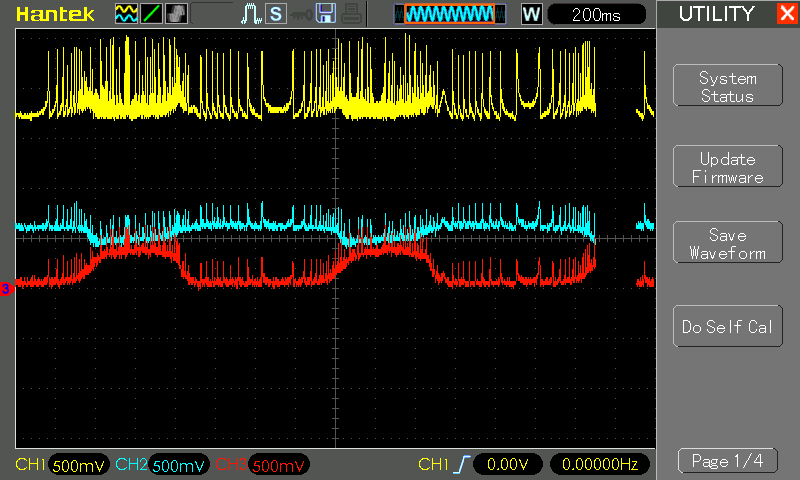
Here's a glimpse of the "modified oscillation". CH2 (red) is the LED cathode/transistor collector - as it rises and falls the LED slowly switches off then back on.


For protoboard-based builds I tend to layout the schematic with PAD tools (Pencil-Aided Design) ...

Wednesday, February 10, 2016

LittleArduinoProjects#182 Building a Bench Power Supply

I've wanted a variable mains-powered power supply for a while, so when I found this kit for a reasonable price I decided to give it a go. Some things that attracted me:

  • 220V/110V mains-powered
  • continuously adjustable output voltage
  • isolated output
  • nice acrylic case
  • built-in LED voltmeter

The kit and PCB comes with a few "valued-added features" unrelated to the power supply function (CD4069 square-wave generator, externally-triggered piezo buzzer, externally-triggered polarity tester), but I decided to leave those out of the build.

I also enjoyed investigating and old-school transformer-based power supply. These are getting rare .. it's hard to even find a 220/12 transformer for less than the price of the kit these days, and then they are mostly used/refurbished.

How does it perform? Nice! No smoke on power-up, but a few things to note and/or improve. And I'm sure it wouldn't pass a safety certification, so don't go building one like this for friends.

As always, all notes, schematics and code are in the Little Arduino Projects repo on GitHub.
LittleArduinoProjects#181 Voltmeter Modules

Voltmeter modules are a very convenient way of adding voltage display to any project, because they require no supporting circuitry or microcontrollers.

There are two and three wire modules in the market. Two-wire modules are the simplest (and generally cheapest). For most applications where a simple readout of a power supply is required, they are most convenient since a separate power supply connection is not required. It does mean of course that the meter draws current from the circuit under test, and will only work down to a certain voltage (usually ~4.5V).

For more precision measurement, the three-wire modules are best as they present relatively high input impedance (> 100kΩ), and can measure voltages all the way down to 0. As an example, Adafruit have this 3-wire module in their catalogue, but they are widely available from most online sellers.

I recently received a 3-wire module as part of a kit and put it to the test. Using my DMM as a reference, it appears accuracy is within 40mV, good enough for general purposes.

As always, all notes, schematics and code are in the Little Arduino Projects repo on GitHub.