my recent reads..

Atomic Accidents: A History of Nuclear Meltdowns and Disasters; From the Ozark Mountains to Fukushima
Power Sources and Supplies: World Class Designs
Red Storm Rising
Locked On
Analog Circuits Cookbook
The Teeth Of The Tiger
Sharpe's Gold
Without Remorse
Practical Oscillator Handbook
Red Rabbit

Friday, June 06, 2008

'Promote Bad Security Practice' Grand Achievement Awards

As usual, Jeff cuts to the heart of the matter on Coding Horror when calling out Yelp for the astonishingly evil and unconscionable act of asking users to hand over their email passwords.

I am not sure who started this, but it has somehow scarily become accepted practice, especially among the social networking sites. Facebook, LinkedIn, Plaxo ... they all do it, and seem to think that waving some privacy mumbo-jumbo 'but you can trust US!' makes it OK. Some are particularly heinous, like Tagged, which obscure the fact that handing over your email password is optional.


As many have pointed out (see the comments on Jeff's post), this is a lazy solution to a problem that is solvable in ways that do not need to compromise user security.

Facebook, LinkedIn - these guys should know better. And I think have an obligation to do better, especially since it is becoming more and more common for a social networking site to be an individual's first experience on the net. While the old hands may have well-ingrained security awareness thanks to the evangelizing efforts of people like Steve Gibson and Leo Laporte on the Security Now! podcast, we have a whole new generation of users being taught exactly the wrong thing thanks to the misguided and irresponsible acts of the social networking sites that are requesting email passwords to be handed over.

The proliferation of this perfidious practice must be reversed! A good first step is to heap professional scorn on anyone associated with developing such a feature. Shame!

Tuesday, June 03, 2008

Oracle Release Timeline with Dipity

Derek Dukes was on net@nite #53 the other week, and it was really interesting to hear him talk about dipity.

Dipity is an experiment in information organisation, with time being the primary dimension currently being explored. Similar in a way to MIT's SMILE widget, which I was investigating a while back for visualizing time-based information.

Dipity shows a great deal of promise, and I like its emphasis on self-discovery and organisation information if directed (rather than everything having to be painstakingly entered). It is certainly a fun way to get lost for a few hours and learn a whole lot of stuff you never set out to study (just go to the home page and start checking out different timelines!)

Ulrich has already worked up a history of Oracle Releases. Not complete, but a fantastic visualisation that would be worth supporting and maintaining!

NB: I'm posting a static image here for now, because the embed code doesn't seem to work in all browsers at the moment.


Adding reCAPTCHA to Oracle SSO - now on sourceforge

Yes, it's time for some house cleaning!

One of my favourite little hacks is how to add reCAPTCHA to Oracle SSO, which I wrote about last year. I've now finally got around to setting it up with its own sourceforge project.

OssoRecaptcha is a demonstration of integrating the CAPTCHA service from recaptcha.org with Oracle Single-Sign-On. It can be used in production OSSO deployments, and also as an example of integrating any 3rd party authentication system with OSSO.

SourceForge.net Logo

Monday, June 02, 2008

Request header rewrites with Java servlet filters - now on sourceforge

Some time back I posted a sample and discussion of request header rewrites with Java servlet filters, and I now finally got around to setting it up with its own sourceforge project.

RewriteRequestHeaderFilter is a Java servlet filter for request header rewrites according to regex rules specified in the servlet init parameters. It is packaged as a sample application and also jar that can be inserted into any arbitrary site.

SourceForge.net Logo

Sunday, May 25, 2008

Config Files for Windows - an Enhancement

In a previous post, I described a general scheme for managing config files for Windows.

Well, there's a simple enhancement that I've added concerning how to locate the config file for the script in question.

The issue is that if I run a script, you always wanted to look for the config file relative to the script location. This can be easily done using Windows Batch Parameter Expansion. %~dp0 expands to the path of the current script, and %~n0 is the name of the script file. Hence, to name the appropriate config file for a script, we generate the name as follows:

set LOCALCONF=%~dp0conf\%~n0-%COMPUTERNAME%.cmd

Blog Stats

I want a t-shirt just like this for my birthday, except I'd change it to "..than MY blog" and add my url;-).


Originally posted on Prata Life..

Business Networking that Doesn't Suck

I really like Geoffrey Grosenbach's ruby on rails podcast, especially because it's not just about rails (even though Rails is a keen interest of mine).

On the latest issue, I was excited to learn about biznik.com. "Business Networking that Doesn't Suck" as they say.

I immediately subscribed, but was disappointed to find that there's nothing happening in my local area yet (Singapore), at least not within 6000km.


Something that we should change soon, especially given the attention paid to entrepreneurship in Singapore. Take the efforts of SPRING for example, or the investment that the government is making in Interactive Digital Media.

I love the idea of this site, and hope to find some local compatriots up there soon!

Saturday, May 24, 2008

Monday, May 19, 2008

Tu Plang, Unit and the Green Papaya


I've had Regurgitator's Tu-Plang and Unit since when I was working in Sydney around 98/99. These albums are classics. I love their sound, and the lyrics are smart. They still get a regular listen, and that's not going to stop.

In a twist, I saw recently on the Food Lover's Guide to Australia that Quan's mother established a Vietnamese restaurant in Brisbane called Green Papaya, and it has great reviews.


It was Hanoi-born Lien Yeomans's dream come true - opening her own restaurant. At Brisbane's Green Papaya she cooks dishes from North Vietnam. She says she has her rock star son Quan to thank for her fame (he’s with the band Regurgitator) but we think it’s her recipes, each one linked to a personal story from her incredible life.


So next time I'm in Brisbane...


View Larger Map

Sunday, May 18, 2008

Calendar


Day to day, our time is marked by weeks, months and years. We take it for granted that no matter where you are on earth, you always know where you are in time.

The calendar is such a routine concept that it takes a book like David Ewing Duncan's excellent and most engaging Calendar to make you stop and think.

A 7-day week is completely arbitrary for instance, apparently originating circa 700 BC in Babylon, and probably influenced by the seven known planets (at the time).

Months are confusion personified. Inspired by the lunar cycle, one is left with the dilemma of trying to fit the cycles within the solar year. The chart below (produced with the open source lcap program) is probably the easiest way to see how the lunar months drift in relation to the solar year. Some, like the Greek astronomer Metron, attempt to rationalise the relationship with great precision (the 19-year Metronic cycle has 7 years of 13 lunar months followed by 12 years of 12 lunar months. Even that is not completely accurate). To most calendarists however, months scarcely retained a notional relationship to the moon, becoming little more than convenient units of time upon which to hang the names of Gods and Emperors.


NB: the difficulty in tracking the moon also came up in relation to the challenge of measuring longitude. Accurate moon charts would have allowed mariners to determine their position even in the absence of accurate time-keeping devices. Predicting the moon's course in the end proved to be much more challenging than building a clock that could survive a nautical adventure and still keep good time. See Dava Sobel's Longitude.

The idea of the solar year - the complete cycle of the seasons from one solstice to the next - is fundamental to how we conceive the passage of time. But we don't often think about the difference between a sidereal year (time for the earth to complete one complete orbit of the sun), and the tropical year (time from one vernal [spring/March] equinox to the next). Or the fact that the year is so very slightly different if you measure between the June or December solstices or the September equinox. And then consider that the Earth is a huge object hurtling through space and subject to varying gravitational forces and other bumps and jitters.

Once you have boiled all this down, it seems a "day" is about the only fundamental unit of calendar time that makes sense. Everything else is just convention and approximation!

Considering the difficulty of measurement, and the many social, political and religious factors involved in common convention, it is quite extra-ordinary that we even have a universally accepted calendar today.

It is easy to forget just how recent a phenomenon this is, and how long its introduction was in the making.

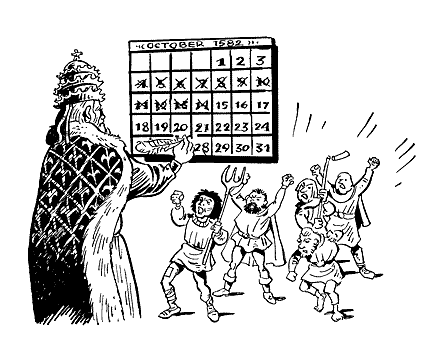
The introduction of the Gegorian calendar required 11 days to be lost for ever!The Gregorian calendar we use today was officially launched by Pope Gregory in 1582, but it wasn't introduced in Britain until 1752 with many countries not adopting it until the 20th century (for example, Russia in 1918 and Greece in 1924). Many quote Mao Zedong declaration of the People's Republic of China in October 1949, which included a point on the adoption of the Gregorian calendar, as the final triumph for a universal calendar (although many cultures still maintain parallel systems such as the Chinese lunar calendar). But do not forget that the flaws in Julius Ceasar's previous calendar had been know long before - the cause of much consternation at the Council at Nicaea in AD325 over the scheduling of Easter, and the subject of the monk Roger Bacon's most distressed entreaty to Pope Clement in 1266 to:
.. apply excellent remedies in this particular .. If then this glorious work should be performed in your Holiness' time, one of the greatest, best, and finest things ever attempted in the Church of God would be consummated.

All of this is of course the background to an epic tale that finds a thread through all peoples over all time.

Which is really the genius of David Duncan's work. He is a great explainer, and in telling the story of the calendar, he tells the story of much of human civilization. And where other "histories of the world" tend to struggle to fit a narrative thread across time and place, the story of the calendar provides Duncan with a perfect segue. The result is the most enjoyable, understandable and effective history lesson I have ever had.

If you have just the slightest interset in history or how the calendar came about as we know it, I couldn't recommend this book more highly.

Other interesting facts:

  • In Britain, New Years Day was celebrated on March 25, the Feast of the Assumption, until it was changed to January 1 in 1752. There are over 30 definitions of New Year listed on wikipedia.

  • Until the modern era of atomic clocks, the most accurate measurement of the year was by Abu Allah Mohammed Ibn Jabir al-Battani in AD 882 (22 seconds short). al-Battani's work came from the same period of Arab innovation that produced modern algebra and added "zero" to the nine Indian symbols that eventually became our familiar number system.


Calendar for December from a French Book of Hours, written around 1470:
Calendar for December from a French Book of Hours, written around 1470
Easter table, England, 1073:
Easter table, England, 1073
Originally posted on Pratalife

Tuesday, May 06, 2008

Configuration Files - a pattern for windows batch scripts

It's a very common practice in perl and linux/unix shell scripting to use an external configuration file (.conf or .properties), keeping all the script's necessary settings organised tidily in one place. This makes it easier to configure in the first place (because you don't have to hunt through the whole script to find what needs tweaking, or which environment variables need to be set), and also makes maintenance of the script so much easier (because you don't need to reconfigure after installing an updated script).

For some reason though, this practice never seemed to get widely adopted in the Windows batch file world. Either Windows script-kiddies just never learned to think like a sysadmin, or we never expected the DOS shell to be capable enough! Or maybe we never bothered, because surely windows batch files should be extinct by now?

I guess the dominant approaches to configuring batch files on Windows are:

  • Command line arguments [painful if you have too many, annoying if they are invariant for your setup, and may entice you to write a wrapper script just to save all the typing]

  • Environment variables [can lead to pollution of your environment, but also not usually backed up along with your scripts]

  • Good ol' "just edit the batch file and fill in the settings" approach


Well, it is possible to take advantage of the elegance of external configuration files. For some time I've been using a technique that I adapted from what I'd normally do with perl and bash scripts. I'm sure this was invented decades ago, but it surprises me that I haven't yet found a good example or tutorial on the net.

So I thought maybe time to polish up the "pattern" and share it here.

The Pattern

It's pretty simple! The flowchart on the right provides an overview.

To make this work with simple windows batch files, we use a configuration file that it itself a batch file (.bat or .cmd) and it is called from the main script. The configuration file would usually set a range of environment variables

A nice usability touch is that when the script is first executed (i.e. no configuration file present), it will generate a default configuration file, give the user some helpful instructions on how to edit the configuration file, and exit.

This makes your script "safe" for users who are liable to run it just to find out what it does(!).

But it also means that you can maintain the default configuration file structure - with as much built-in documentation as you like - inside the script itself (therefore only one file to maintain).

The Script Template

Here's a script template that includes the configuration file handling (also available for download here). As you can see, not rocket science!

If you have multiple scripts that all need to share a common configuration, you can extract the config file handling as a separate script and include (call) that from all the others. See the scriptTemplate.cmd and config.cmd in this kit of examples.
@echo off
REM $Id$

setlocal

echo Welcome to %0

REM Initialise the config flag [CONFIGSET] and config file [LOCALCONF]
REM You must name the config file .bat or .cmd to ensure Windows can execute it cleanly
set CONFIGSET=NO
set LOCALCONF=%~dp0conf\%~n0-%COMPUTERNAME%.cmd

REM ===============================================================
REM Configuration section
REM ---------------------------------------------------------------
if "%LOCALCONF%"=="" goto config_help
goto config_do


:config_help
echo This is a configuration help script
echo Call from another script with first parameter being the config file name
echo This script will set the variable CONFIGSET
echo CONFIGSET=NO in the case of error or undefined configuration
echo CONFIGSET=YES in the case where configuration has been successfully read
goto config_exit


:config_do
REM handle configuration file
IF EXIST %LOCALCONF% goto config_cont

REM generate default setting file
REM adapt this to you needs. Here are some samples
echo REM configuration file> %LOCALCONF%
echo set JAVA_HOME=C:\bin\jdk1.6.0_03>> %LOCALCONF%
echo set TMPFILE=c:\temp\mytemp.txt>> %LOCALCONF%
echo set SUBJECT=A subject line>> %LOCALCONF%
echo set DBUID=dbusername>> %LOCALCONF%
echo set DBPWD=dbpassword>> %LOCALCONF%

echo #
echo # Local configuration not yet set.
echo # A default configuration file (%LOCALCONF%) has been created.
echo # Review and edit this file, then run this process again.
echo #
goto config_exit


:config_cont
call %LOCALCONF%
set CONFIGSET=YES


:config_exit
if "%CONFIGSET%"=="YES" goto config_ok
echo Configuration is not set
goto exit
:config_ok
REM ---------------------------------------------------------------
REM Configuration section ends
REM ===============================================================


echo The main script starts from here.

echo The following configuration is set:
echo JAVA_HOME=%JAVA_HOME%
echo TMPFILE=%TMPFILE%
echo SUBJECT=%SUBJECT%
echo DBUID=%DBUID%
echo DBPWD=%DBPWD%


:exit
endlocal


Sample Output

Here's an example of running the script above. The first time through, no configuration file is detected, so it creates one and exits.

At that point, the user could edit the configuration file if necessary.

Subsequent runs pick up the settings in the configuration file.

D:\MyDocs>scriptWithConfigTemplate.cmd
#
# Local configuration not yet set.
# A default configuration file (scriptWithConfigTemplate-conf.bat) has been created.
# Review and edit this file, then run this process again.
#
Configuration is not set

D:\MyDocs>scriptWithConfigTemplate.cmd
The main script starts from here.
The following configuration is set:
JAVA_HOME=C:\bin\jdk1.6.0_03
TMPFILE=c:\temp\mytemp.txt
SUBJECT=A subject line
DBUID=dbusername
DBPWD=dbpassword

D:\MyDocs>

Sunday, May 04, 2008

Complex ACL filters with OVD

Access Control Rules are a very important aspect to get right when setting up Oracle Virtual Directory. But at the same time, I guess they are probably the most complex configuration option, especially if you haven't had some hard core LDAP experience before.

In Using OVD Filtered Directories for LDAP Authentication, I talked about using ACLs to restrict access to certain parts of a directory: each Access Control Rule has a filter setting, which is an LDAP filter that specifies which directory entries the rule applies to.

However I also discovered that using complex (multiple term) Access Control Rule filters is a great way to kill the OVD server process.
NB:it bombs with a java.lang.NullPointerException, and it is necessary to go and manually remove the offending filter from the $OVD_HOME/conf/acls.os_xml file on the server before it will startup again.


Say, for example, you wanted to grant access to entries for the ITGroup and HR departments. In RFC 4515 LDAP search filter terms, we can write this simply as:
(|(departmentNumber=ITGroup)(departmentNumber=HR))


But as mentioned, this will kill your OVD server (OVD 10.1.4.0.1 build 06.07.19).

There is a simple work-around though, by reverting to simple set theory and write multiple rules. In other words, granting (|(departmentNumber=ITGroup)(departmentNumber=HR)) is equivalent to two rules applied in sequence:
  • Grant: (departmentNumber=ITGroup)
  • Grant: (departmentNumber=HR)

Sunday, April 13, 2008

Innovation and Two Book Recommendations


There's a great quote in Chad Fowler's My Job Went to India which I just posted a quick review of:
In business, ideas are dime a dozen. It's the blood, sweat, tears and money you pour into a product that make it really worth something.
I'd extend that and link it to a later part of the book that focuses on Execution.
To be successful, raw ability will get you only so far. The final stretch is populated by closers - people who finish things.
As Theodore Levitt said:
Creativity is thinking up new things. Innovation is doing new things.
In other words, the key is doing. One of my pet subjects;-) I can come up with a million creative ideas, but without follow-through, its all just a bit of mental fun.

An excellent companion read is Scott Berkun's The Myths of Innovation.

Get them both on your bookshelf! The sooner, the better.


My Job Went to India (and all I got was this lousy book)


The title may be provocative, and immediately engender some strong reactions, but having just read My Job Went to Indiaby Chad Fowler, I'd strongly recommend you get past the emotions and read this book now!

It is actually a very sensitive and insightful treatment of career pressures of the modern age, and how to respond positively. Although primarily targetted at a those working in the software industry, the book is a great career coach for any white-collar information worker.

The book contains 52 very well-written pieces of advice, all introduced with some fascinating personal introspection.

Get it on your bookshelf! The sooner, the better.

Tuesday, March 25, 2008

A380 - how to spend €billions and still get simple things wrong

lancerlord@tomorrow.sg picks up on a Telegraph article asking "why are there still ashtrays in the Airbus A380?"

Good question, but not the only example of seemingly stupid "missed opportunities" to innovate in the A380.

One of the first I noticed was the new positioning of the inflight entertainment controller in the seat back. At first it seems perfect, since it avoids the accidental activation which is a real problem when the controller is built into the armrest (which is the case in most other cabin fitouts I've seen).

But then consider the way it is oriented - mounted on the side. This results in a classic failure to "get the mappings right" (one of Norman's design rules in "The Psychology of Everyday Things"). If you use the controller without removing it from its holder (which turns out to be a very handy usage), then you need to transpose the controls 90°. Up means right, down means left etc. Ironically, when the controller is mounted in the armrest, the horizontal layout tends to "get the mappings right" if you use it in-situ because of the way the hand is positioned.


It could have been so perfect if the controller designers were collaborating with the seat designers, with a clear focus on usability. The controller could be mounted vertically, or redesigned for a side-side layout.

As it is, a missed opportunity to produce the very best design. And a very, very minor usability problem is one of my lasting impressions of my first A380 flight, overshadowing all the billions of euros invested in the plane.

What else? Well, I'm surprised they persist in using the special 2-prong audio jack. I'm sure there's some weird logic about discouraging passengers from nicking the headsets (even though policing headset issue and collection still seems to rate as one of the cabin staffs' most important duties!)

But as I look around the cabin more and more people are using their own earphones. The ones that aren't probably forget to bring the special adapter. For planes like the A380 starting their service life in the 21st century, I'd expect it would be the norm for most air travellers to be carry a headset of some description, and it would make sense for cabin designers to take advantage of the fact and use standard audio sockets, and provide headsets "by exception". Win-win: passengers get to use their own familiar headsets without needing an adapter, and cabin crew get to save time for more important things.

See, I can get cranky about the smallest details;-)

Expect users to be just as critical, nitpicking and cranky about the software we give them! And rightly so... it doesn't really matter how much time and money has been invested if you don't get the simple things right.

Earthcore & Infected


Scott Sigler has the book launch of Infected coming up on 1-Apr. No joke, you can pre-order on Amazon already.
..a cinematic, relentlessly paced novel that mixes and matches genres, combining horror, technothriller, and suspense..

Sigler's been one of the stars of the free podcast-audiobook scene, and its great to see him on the mainstream bookshelves. In fact, you can still get Infected as a podcast download here at podiobooks. Sigler reads his own works, and he's got the voice for it too. See the Infected promo page at podiobooks for more info.

Earthcore was the first Sigler novel I came across, also highly recommended. I found it some time ago, before I started blogging about books actually, which is why you are only seeing a post about it now.

I listened to Earthcore as a podcast available here at podiobooks. In fact I think it was my very first podiobook download, and got me hooked on the whole podiobooks idea (from which I've since discovered other great authors like Terry Fallis and Nathan Lowell).

These authors are all making podcast versions of their works freely available. It is a fantastic way to discover new authors and enjoy their books in audio. They deserve our support if you like what they do. Podiobooks takes donations directly. And for authors like Sigler we can buy their books in print too!


Originally posted on It's a Prata Life

Monday, March 24, 2008

Got a License to Operate Your Brain?


Geoffrey Grosenbach took a diversion on the Ruby on Rails podcast recently, with a fascinating two-part interview with John Medina (part 1, part 2).

Medina is a very engaging speaker, with some controversial but well researched ideas on how the brain works, and why so many of our social conventions in school and the workplace actually conspire against optimal brain performance. I gather its a discussion of many of the ideas from his book Brain Rules.

Well worth a listen.

Sunday, March 23, 2008

Clear Timezones and jQuery

Choon Keat recently posted a great little web tool to help simple scheduling across timezones.

Makes it really easy to have a quick look at how times line-up around the world. For example, I've saved this link to see Vancouver (my sister), Melbourne/Sydney (most of the rest of the family) and Singapore (me) all in one go.

It's done in pure Javascript, and is a good example of jQuery in action if you care to look;-)

See also: timeanddate.com for encyclopaedic coverage of everything related to times and dates.

The Psychology of Everyday Things


POET - the familiar name that Donald A. Norman gave his 1988 classic "The Psychology of Everyday Things" which I recently picked up in the library. It has since been updated a little and reissued as The Design of Everyday Things. But I like POET.

There is, after all, great poetry to be found in the workings of even the simplest device. And when things are not so artfully conceived: great tragedy and boon for cranky geeks everywhere.

How can one not enjoy, for example, subjecting alarm clocks that have identical "snooze" and "reset" buttons to exemplary castigation? Or lambasting the purveyor of inappropriate door handles: those that are designed to "pull", but require a label that says "push" because that is the way the door swings?

Norman's approach is refreshing.
Humans do not always behave clumsily. Humans do not always err. But they do when the things they use are badly conceived and designed. Nonetheless, we still see human error blamed for all that befalls society.


Despite being published in 1988 and primarily drawing its examples from the world of simple electro-mechanical devices, the book's philosophy and advice is remarkably enduring.

It is all about user-centered design, and as relevant today as it was in Internet Prehistory. Norman posits Seven Principles of Design:
  1. Use both knowledge in the world and knowledge in the head
  2. simplify the structure of tasks
  3. Make things visible: bridge the gulfs of Execution and Evaluation
  4. Get the mappings right
  5. Exploit the power of contraints, both natural and artificial
  6. Design for error
  7. When all else fails, standardize

The Lego Heresy

I do take issue with one example however. Norman presents the case of a Lego police motorcycle model as an example of excellent design.

Why? The design cleverly exploits physical, semantic and cultural constraints so that there is basically only one construction solution.

Which is great if the objective is to make construction quick, easy and repeatable with a high degree of quality.

Great! Its teaching kids how to be highly productive assembly line workers.

And that is where I think Lego started to go badly wrong. New Lego, personified by custom molded pieces and kits that could only make one design, may win design awards.

But it does not serve it's purpose and it's users. The beauty and enjoyment in Classic Lego came from the very fact of its flexibility and lack of constraints. With a little squinting, it was possible to believe you could build anything. As Norman himself argues, there are situations where it is useful to pervert the design principles (such as with safety features).

Classic Lego is a perfect study in the appropriate application of Norman's principles in reverse, whereas New Lego is just a great way to waste money.

To mangle a famous quote..
Give a child a Lego Police Motorcycle Kit, and you have bought a few hours of peace.
Give a child a Lego Basic Bulk Set, and they are set for a lifetime.

Which would you prefer?

Originally posted on It's a Prata Life

Sunday, March 16, 2008

Cryptonomicon


I've had my head in Neal Stephenson's Cryptonomicon for the past few weeks and finally finished it. Seriously, at a thousand-over pages, its not one to knock over in an evening.

But it is a fantastic tale. Actually more like three tales in one.

It makes me wonder how he does it. The writing is like stream of consciousness, and I guess it would need to be judging how prolific he is (I haven't even started on the baroque cycle). Yet if mere mortals like you or I would try this, I am pretty sure the result would be pure tripe.

Cryptonomicon is anything but.

I am dazzled and intrigued by the miscellaneous tangential twists and turns of the narrative, and the incredibly inventive detail that scatter the way, like breadcrumbs leading to a safe haven.

Little things such as his similes.
.. dead-monitor-screen grey..
Now isn't that brilliant? Surely deserves a named place in the CSS Color Palette if I were the judge!

And subtle digs that flit by if you are not paying attention.
"You know what that is? It's one of those men-are-from-venus, women-are-from-mars things"
"I have not heard this phrase but I understand immediately what you are saying."
"It's one of those American books where once you've heard the title you don't even need to read it," Randy says.
Oh so true.
"Then I won't."
Priceless!

Originally posted on It's a Prata Life.

Saturday, March 15, 2008

drop.io - cool & effective "media" sharing

..I hesitate to say "file sharing" because it gets funkier than that. Record somthing on your phone, mail to your drop.io drop, and it shows up as an enclosure on an rss feed = instant podcast!

The basics are solid - dead simple file sharing. First heard about this on net@nite; definitely worth checking out.

If - for some reason I can't think of right now - you wanted to send me a file, you can now drop it on my drop.io widget:

drop.io: simple private sharing

Using OVD Filtered Directories for LDAP Authentication

Oracle Virtual Directory (OVD) is one of the little-known or understood hero products in the Oracle suite of technology offerings [I put OEM Grid Control in the same class].

In this post I'm going to share a few thoughts on OVD, and present a few approaches for using OVD to present a restricted view of information from another directory, and how that can be used to limit access to applications that use an LDAP authentication mechanism.

When I was first learning about OVD back in early 2007, after the Oracle acquisition, it immediately grabbed my attention. Simple, easy to use, but so powerful - a swiss army knife for anyone working in the directory management space. Maybe that is the wrong analogy, because the greatness in OVD is that it doesn't try to boil the ocean - it just does one thing, but does it really well.

Simply put, it allows you to combine directory-related information from disparate sources (LDAP, AD, database etc) and present an LDAP-compliant view in real-time. And the virtual bit is real (if that makes any sense) - OVD doesn't store anything, unlike a meta-directory; it just passes through the directory requests according to the rules you setup.

The virtual nature makes OVD ideal in large enterprise situations, where control of directories may be distributed. Another group may have a directory that contains some information you want to use as part of your "directory view", but are not going to cede any ownership or agree to any changes anytime soon, like adding some new attributes. Wheel in OVD!

Likewise, affiliated companies may want to share directory information, but not handover control. And if the business relationship comes to and end, the directory owners want to know that they can turn off access in a moment, without needing worry about cached or replicated data left on the other side of the corporate divide. OVD to the rescue!

Case in Point: you need a subset of an existing directory

The inspiration for this post is a small challenge I was involved with recently. The company was deploying a new web application - just happened to be Oracle WebCenter Wiki, but the same applies to any application that supports LDAP authentication.

The only directory available contained a mix of users - some who should be able to access the wiki, and some who shouldn't. Configuring the wiki authentication mechanism at the directory is simple - but it is an all or nothing proposition. And of course, we couldn't go change anything the directory itself.

Sounded like a job for OVD!

Here's the basic setup - OVD is deployed between our application and the main directory, like a proxy server. We want to OVD to effectively "filter" requests from the application.

Configuration of OVD is done using the OVD Manager client, which connects to the administration port of the OVD server.

Approach #1: DN Matching

If you can define the distinction between included/excluded entries in terms of an entry's DN, then a very simple solution is to use the "DN Matching" property of the source adapter. This is fund in the Routing configuration.

Say for example, we only wanted our OVD directory to include entries that are in the ou=ITGroup or ou=Management containers. In this case, we would set the DN Matching property with a regular expression that will match on the DN string:
m/(.*)ou=(ITGroup|Management)(.*)/


Approach #2: ACL Restrictions

In practice, the DN may not provide enough information to distinguish items to include and exclude, and it is necessary to discriminate on the basis of an attribute, such as "departmentName". In this case, access control in the OVD engine may be configured to restrict the directory view based on a suitable filter.
Filter: departmentName=ITGroup


It is important to note with this approach that ACLs can be applied to all LDAP operations, except bind.

As a result, the directory view we have created with OVD appears to only contain the filtered subset of information: we cannot browse, serach, get or modify anything else. However, if you present a fully-qualified DN and associated password, it will authenticate and bind any entry that exists in the source database.

On spec, that seems to blow the whole approach out of the water. That's what I was thinking too, until Mark Wilcox helpfully nudged me along with a neat insight...

If our requirement is to use OVD to restrict the set of users that can authenticate via an application, we only need to consider the application authentication mechanism. In most cases, the process is similar to the one illustrated below. The user enters an id or username, which is used by the application to lookup the user's DN, which is then used to bind along with the user-supplied password. If the application can't find the DN in the first place, then no bind is possible.

Of course, the acknowledged security "exposure" in this case is that a user can bypass the application and directly bind via OVD if they know their DN. However this is probably a false risk, because the user would have always had a similar capability with the source directory itself (assuming that the source directory and OVD are equally accessible to the user over the network).

Bottom line? Using ACLs to restrict the search effectively controls the set of users that the application can authenticate.

In Practice: Oracle WebCenter Wiki

Oracle WebCenter Wiki is thye example application, but you can think of it as any old J2EE application packaged as an EAR that supports Java SSO. By default it will use JAZN XML file-based storage for user accounts.

When deployed in OC4J, the security provider used for the Wiki application can be easily changed via the Enterprise Manager web interface.


Switching to OVD as the authentication source is a simple matter of selecting the Oracle Security Provider for 3rd Party LDAP Server and configuring it with some simple directory details:


Almost done. There are two assumptions that I think the wiki makes about the directory. Just need to make sure these are setup:
  • wiki users must be members of the group called "users"
  • administrators are members of the group called "oc4j-administrators"

Now you are done. The wiki authentication is being performed against the limited set of users visible through OVD.

Caveat: selecting the Oracle Security Provider for 3rd Party LDAP Server causes the site to revert to basic authentication (i.e. popup a username/password dialog instead of using a web form). Not a big deal, but you will find the "logout" feature in the wiki now fails because it assumes form-based custom authentication. So once you have people lured into your wiki, they are trapped! ;-)

Wrapping Up

I've covered two techniques for restricting the set of information published via OVD: DN Mapping, and ACL Filters.

There are other approaches that I've not covered here. For one, Java or Python plug-ins (a.k.a. mappings) can achieve the same result, as well as more complex behaviours of course.

These techniques allow OVD to be used to restrict overall access control for applications that use LDAP authentication mechanisms.

Once again, hat-tip to Mark Wilcox for his help when I thought I'd hit a wall while researching this topic!

Sunday, March 09, 2008

Desktop Keyboards Stuck in Design Limbo

Keyboards are terrific examples of how bad design can get stuck in a rut, unable to overcome inertia. Everyone says qwerty is a bad idea, yet I couldn't imagine using anything else now since it's use is so ingrained.

But another aspect of keyboard design that has me really grumpy is the whole numeric keypad appendage on desktop keyboards. It is a holdover from the days when users were "data entry clerks". But we are stuck with it (Microsoft only have two keyboard models without it, while ALL Logitech models are saddled with this cancer Postscript: Dean Chu corrected me here; Logitech's diNovo models don't have the numeric keyboard).

This started to really annoy me of late, because I've been switching between a laptop during the day, and a desktop at night.

Working with a desktop keyboard again was feeling really strange and difficult, but after some reflection I realised the problem. My right-hand is used to shifting all the time between jkl; and the mouse. On the laptop, this is a subtle and effortless gesture. On the desktop, its like playing table tennis.

The fact that virtually all laptop designs eschew the separate numeric keypad should be proof that it is evolutionary dead wood.

So this is my grumpy call for all keyboard manufacturers to wake up their snoozing product managers/designers and actually innovate for once. Fix this ergonomic nightmare! At least give us some choice ... integrate it with function keys like laptops; use separate USB numeric keypads; even consider sticking it on the left-hand side of the keyboard.

And for all those poor souls who really are still data entry clerks, I'm sure there will be no-brand outfits from China knocking out standard 102-key designs for years to come.

Is it just me? Did I get up on the wrong side of the bed today, or do others feel this way too?

Postscript 9-Feb-2009 ... hat tip to mqt for linking Trevor Blackwell's solution: just chop it off! If you gotta take a bandsaw to a product to make it fit-for-use, then something's wrong, right?!!

Saturday, March 08, 2008

Appcelerator - bringing down the wall between RIA and SOA?

I wonder if the Appcelerator guys have finally cracked the RIA and SOA dichotomy? I first came across them on Coté's RIA Weekly #008 RedMonk Radio podcast.

I've presented my views before on what I see as the three megatrends in IT:
  • Web 2.0 - or more generally, RIA
  • SOA
  • Grid - although today I'd probably update this to be "Cloud Computing"


But the distinction between RIA and SOA has always felt forced; unrelated working metaphors, owing more to the historical segregation of the communities addressing each than strict architectural principles.

While industry lines have been drawn very clearly around these two domains (take OpenSOA v. OpenAJAX for example), there have been many attempts to nibble away at the distinction. AJAX toolkits like SAJAX and SWATO strive to make calling back-end resources more convenient. And frameworks like ADF approach the problem from the other end, by "hiding" AJAX rendering in their server-side, SOA-aware paradigm.

So what has Appcelerator got to do with this?

From what I understand so far, the key is that they have unified the event/messaging model both within the browser and the "SOA-sphere", and done so in a very elegant way. There are three parts to their solution:
  • Web Expression Language
  • RIA Widget Framework
  • RIA Message Broker

All components in an Appcelerator application communicate via simple lightweight messages using the RIA Message Broker. On the server-side, Appcelerator provides a set of SOA Integration Points that enable service creation in Java, PHP, Ruby, .NET, Python and Perl.

On the client, the Web Expression Language message-enables HTML elements. The RIA Widget Framework is a Javascript-based API that enables you to create new widgets and wraps existing third-party widgets like scriptaculous.

The end result is a very clean, lightweight and seemless development approach. HTML attributes define behaviour: what messages to send, and what to do when a message is received. And the real magic: when you send a message, you do not know or care if it handled by another HTML element on the same page, or a SOAP Web Service somewhere out on the net.

Here's how straight-forward it gets. An example of an input button messaging a calendar widget to show itself..
<html xmlns="http://www.w3.org/1999/xhtml" xmlns:app="http://www.appcelerator.org">
...
<app:calendar title="Pick a Date" on="l:show.calendar then execute" inputId="mydate">
</app:calendar>
<input type="text" id="mydate" value="click me" on="focus then l:show.calendar"/>
...

Or an input button sending a message...
<input type="button" value="submit" on="click then r:login.request"/>

.. that is handled by a Java service:
import org.appcelerator.annotation.Service;
import org.appcelerator.messaging.Message;

public class LoginService
{
@Service(request = "login.request", response = "login.response")
protected void processLogin (Message request, Message response)
{
// get request data
String username = request.getData().getString("username");
String password = request.getData().getString("password");

User user = userDAO.login(username,password);

// format response
if (user != null)
{
response.getData().put("success",true);
response.getData().put("user",user);
return;
}
response.getData().put("success",false);
}
}

Appcelerator looks like one to definitely watch closely and investigate further..

Proven Enhancement

Never has Rails Trac been more entertaining than this. The change history is just too funny;-)

Sunday, February 24, 2008

Quick NLB Catalogue Lookups

Postscript: I've given up all ambitions of hacking NLB now that I have discovered Bookjetty - a bookshelf site with library integration. Check it out!

OK, so this post won't mean diddly unless you live in Singapore, or have a local library using the CARLweb system.

But say you are browsing one of the book retailers on the web - like amazon - and you want to know if the book is available in your local library?

Here's a little trick to help you find that out in one-click (not patented;-). It is inspired by some posts over at The Box Factory.

Below is a link that you save to your bookmarks (Firefox)/favorites (IE). Once saved, when you are on a book page at amazon etc, just select the bookmark/favorite and it will pop-up a window to Singapore's National Library Board catalogue system and try and find the book in the library for you.
NLB Book Lookup <-- Bookmark/Favorite this!

Simple steps: How to Use It

  1. Right-click on the link above, and select Bookmark This Link.. (Firefox) or Add to Favorites.. (IE)

  2. Go thru the steps to save the link. you may get a warning about "javascript:" links not being recognised. Ignore/proceed .. trust me!

  3. Check you Bookmarks/Favourites menu - should now find NLB Book Lookup in the list.

  4. Navigate over to a book retailer and find a book (try the Ruby Cookbook (O'Reilly) at Amazon for example)

  5. While viewing the book page, select NLB Book Lookup from your Bookmarks/Favorites menu

  6. A new window will open to display the NLB Library Catalogue record (if there is one)

Grumpy Stuff - But Looking Forward

The NLB is still using CARLweb, which is an ancient product from TLC.

Once of the really nasty features of this system is that it uses session tracking in the URL query string of your request. Not only does this prevent deep-linking (so you can't easily email a catalogue link to a friend for example), it makes the catalogue un-indexable by web search engines like google.

It also means that the Bookmark/Favorite link I gave you above has to go in the front-door, and creates a new session each request. So unfortunately that means that if you use this a few times in quick succession, you may get a maximum sessions exceeded error. Sorry, for now you'll just have to close the windows and wait a while for sessions to expire.

Yes, CARLweb sux. It truely belongs to an earlier era of computing!

The good news: I've heard whispers that the NLB have a project running to upgrade their catalogue search facilities. Hopefully we'll soon have a much better service to use. My top wishes:
  • Support for deep-linking. No user/session-related information in URLs.

  • A nice robots.txt that allows the search engines to fully index the catalogue

  • Flexible RSS feeds - as well as the usual "latest acquisitions" etc, a flexible and published approach to parameterising the feed e.g. by library location, by subject and any other search criteria. Or another way to express this would be "get any search result as RSS"

  • Getting ambitious now ... a published Web Service/REST API

  • A mashup developer's guide - encourage people in Singapore to exploit the NLB catalogue! A competition even?